Understand how a lawyer assesses land disputes, organises property evidence, selects the correct procedure and plans a practical, lawful resolution.
Lawyers who settle land disputes help clients turn a disagreement about property into a defined legal claim supported by evidence. The work may concern the right to use a parcel, a disputed boundary, access, a transfer agreement, inheritance or an administrative land decision. These matters do not all follow the same procedure. Effective advice starts by identifying the affected right, the remedy sought and the records available, then choosing a route that can deliver a legally workable result.
The first meeting should establish what is actually disputed. Does a neighbour claim the same strip of land? Has a seller failed to complete an agreed transfer? Do heirs disagree about the property forming an estate? Is the problem a decision by a land-management authority? A description such as “recover my land” may conceal several different legal relationships and require more than one type of claim.
Record the parties, the parcel identifiers, the history of possession and registration, and the important dates. Identify who is named in the certificate, who currently uses the property, and whether anyone else claims an interest. Occupation, payment and registration are relevant facts, but none should be treated as a complete answer without examining the legal history and the particular issue.
For lawyers who settle land disputes, a useful initial assessment separates the client's objective from the available remedy. Restoring a boundary, obtaining payment, challenging a decision and dividing inherited property involve different requests. The lawyer should explain which facts support the proposed claim, which remain uncertain, and what further records are needed before recommending negotiation or proceedings.
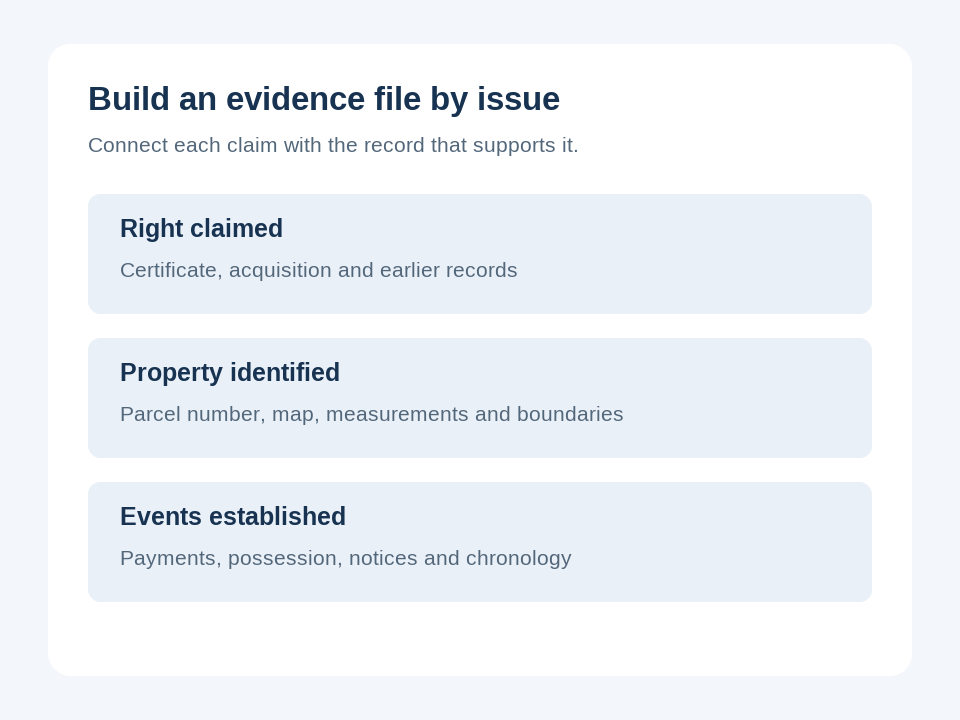
Land files often contain documents created at different times for different purposes. Collect the relevant certificates, cadastral records, transfer documents, allocation records, payment evidence and correspondence. Include earlier records where the origin or continuity of the right is disputed. A certificate number without the associated parcel and map information can be insufficient to understand a boundary allegation.
Prepare a chronology showing acquisition, registration changes, construction, occupation and the first identifiable disagreement. Keep original documents safely and make readable copies. Where copies conflict, identify their sources and dates rather than choosing the version most favourable to the claim. A lawyer can help formulate requests for records held by an authority or another participant through the appropriate procedure.
A boundary case should identify the disputed area on an understandable plan, supported where appropriate by measurements and historical records. Photographs may show a wall or fence but do not necessarily establish the legal boundary. Similarly, the existence of a path does not alone determine the source, extent or conditions of a claimed access right. Record how it has been used and what documents or agreements relate to it.
For example, if a new fence appears to reduce access to a house, distinguish the physical obstruction from the legal basis of the access claim. Preserve dated photographs and relevant plans without moving markers or damaging structures. The evidence should allow the decision-maker to understand both the location and the right being asserted.
The current Land Law encourages settlement and provides for commune-level conciliation before the competent authority resolves the land disputes covered by Articles 235 and 236. Article 235 sets a period of no more than 30 days from receipt of the conciliation request. Older references to a general 45-day period should not be used as the current rule for this procedure.
The nature of the dispute still matters. Judicial guidance distinguishes a dispute over who holds the land-use right from other disputes involving land, including transactions, inheritance and division of spouses' common property. Do not assume that the mere involvement of a parcel makes commune-level conciliation a filing prerequisite for every civil claim. Classification should be checked against the current law and the actual requests before proceedings begin.
Where conciliation is required, prepare the application and supporting documents, clarify the issues for discussion and retain the resulting written record. Check that it accurately identifies the parties, property, agreed matters and unresolved points. An unsuccessful outcome does not establish which party is right; it records the procedural result and helps define the next stage.
Before agreeing, check the proposed boundary, any payment, the documents to be signed and the sequence for implementation. Consider whether registration or another official step is necessary. Article 235 addresses submission for registration where successful conciliation changes boundaries, area or the land user. A general promise to “resolve the matter later” can leave the central disagreement intact.
Article 236 distinguishes disputes involving a certificate or specified land papers from disputes without those documents. The former category, and disputes over assets attached to land, fall within the court route described by that provision. Where the relevant papers are absent, the law provides a choice between the competent administrative settlement route and a civil lawsuit, subject to the applicable conditions.
Read those rules together with the current allocation of administrative responsibilities. Vietnam's two-level local government arrangements changed the exercise of certain land powers. A lawyer should verify the competent authority and current filing procedure for the particular case, rather than reuse a former district-level address simply because it appears in an older article or document.
Court jurisdiction also requires a current assessment. The amended Civil Procedure Code provides regional People's Courts with the relevant first-instance jurisdiction, subject to its rules. For a dispute whose object is immovable property, Article 39 provides the territorial rule tied to the property's location. A claim merely connected with land should still be classified carefully before applying that rule.
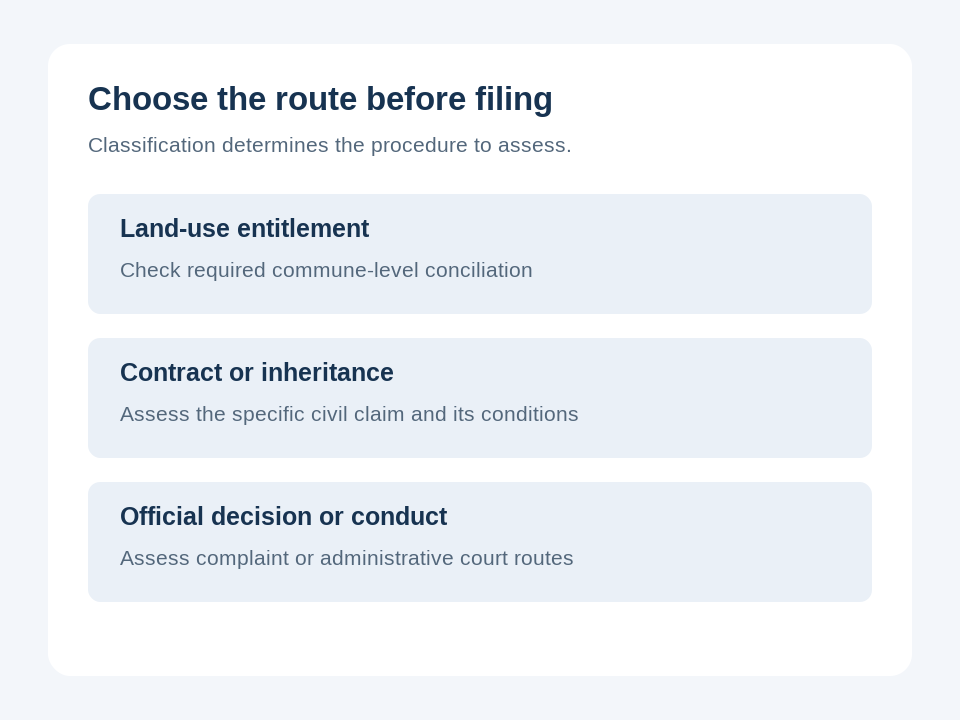
A civil claim between parties concerns the disputed private rights or obligations. A challenge to an administrative land decision or conduct follows the relevant complaint or administrative court procedure. The fact that a public authority holds useful records does not automatically make it the opposing party in a civil dispute. Equally, a claim concerning a certificate may require examination of the legal effect of an administrative decision.
Where the problem concerns the legality of an official decision or omission, the separate guide to complaints related to land and houses explains the administrative complaint framework. Decide how the available routes interact before filing overlapping requests. Acceptance of proceedings in one forum can have consequences for another procedure.
Article 155 of the Civil Code excludes the lawsuit limitation period for land-use-right disputes under land legislation. That does not mean every claim involving property is unlimited. A contract claim and a request to divide an estate require their own limitation analysis. The requested remedy and legal relationship matter more than a general label such as “land case”.
For example, the Civil Code generally provides a three-year limitation period for contract disputes from the relevant knowledge of the infringement, while its inheritance rules distinguish different requests and periods. Historical circumstances, transitional rules and legally recognised interruptions or exclusions may also require review. Administrative complaints and administrative lawsuits have separate deadlines. Obtain a dated assessment rather than postponing action on the assumption that land claims never expire.
A court file should explain the legal relationship, identify the participants, state the remedy and attach the available supporting evidence. Check whether other co-holders, heirs, occupants or secured parties need to participate. Leaving out a person whose rights may be affected can complicate the process and reduce the practical value of the eventual decision.
The work of lawyers who settle land disputes may include drafting the claim, preparing evidence submissions, addressing requests from the court and advising on measurements, valuation or expert issues. Where an urgent protective measure is considered, explain the particular risk and the legal requirements for that measure. Filing a case does not automatically freeze every transaction or authorise a party to take possession by force.
Representation should be documented through the appropriate authority and agreed scope of work. Discuss which tasks the lawyer will perform and which require the client's attendance, information or approval. Translation and authentication may be relevant to foreign documents. Advice should reflect the client's actual status; speaking English or residing abroad does not itself determine entitlement to Vietnamese land-use rights.
A realistic settlement assessment compares the evidence, likely procedural steps, ongoing disruption and whether the proposed result can be implemented. A boundary agreement may need a precise drawing and registration work. A payment arrangement may need security or staged performance. A transfer settlement may require review of legal eligibility and the documents necessary for completion.
Ask for a clear explanation of professional fees, expected work and potential third-party costs. Depending on the matter, these may include court-related payments, measurements, valuation, translations or expert services. Avoid treating an early estimate as a guarantee of the final cost or timetable. New evidence, additional parties and procedural developments can change the work required.
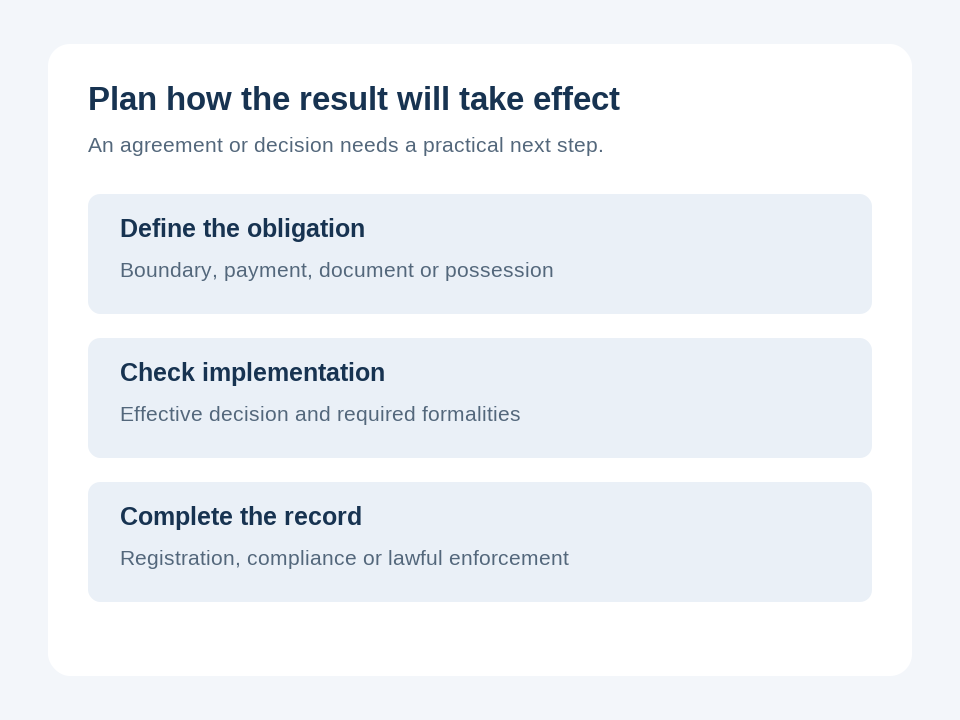
A favourable decision also needs an implementation plan. Identify what each party must do, whether the decision is effective, and whether civil enforcement, registration or another official process is required. Keep evidence of voluntary compliance and seek advice on the applicable enforcement procedure if it does not occur. A judgment is not permission for unlawful self-help.
Bring the principal property records, the challenged agreement or decision, any conciliation record and a concise chronology. Identify missing documents and the dates on which important notices were received. Explain the practical objective, including whether access, occupation, payment or registration is the immediate concern. This allows the initial advice to focus on choices that can affect the case.
A consultation with Jurion & Partners can use that file to assess the legal relationship, evidence gaps and available procedural routes. Ask for the proposed next steps and the reasons for them. A professional assessment should describe material uncertainty and practical requirements without promising a particular judgment or an artificially short resolution.
Choosing lawyers who settle land disputes should therefore involve more than finding someone to submit an application. Look for a reasoned plan connecting the disputed right, the evidence, the competent forum and an implementable remedy. Preparing that foundation early makes negotiation more informed and gives any necessary proceedings a clearer focus.






Subscribe today to get more breaking news from Jurion Partners - Solicitors & Litigators

108 Tran Dinh Xu St., Cau Ong Lanh Ward, Ho Chi Minh City, Vietnam
(+8428) 66.701.709 - (+84) 903.419.479
contact@jurionpartners.com
Follow us
Accept payment





 English
 Tiếng Việt