A practical guide to administrative complaints about land and housing decisions, with current acceptance periods, evidence preparation and procedural choices.
Land and housing complaints in Vietnam require more than a statement that a property decision is unfair. The person complaining must identify the administrative decision or conduct, explain how it directly affects lawful rights or interests, and ask the competent authority for a specific remedy. A dispute with a neighbour, a contractual claim against a developer and a complaint about a land-management decision may concern the same property but follow different procedures. Understanding that distinction helps protect deadlines and produce a useful case file.
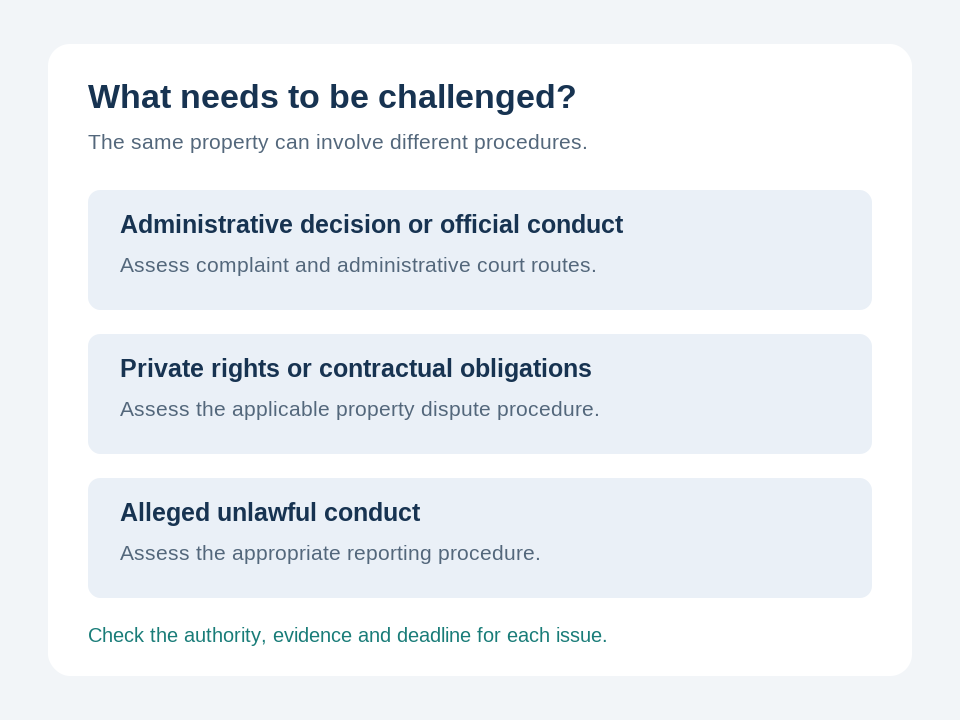
An administrative complaint asks for reconsideration of an administrative decision or administrative conduct believed to be unlawful and directly harmful to the complainant's lawful rights or interests. The conduct can include failure to perform an official duty. A refusal, delay or omission should therefore be examined against the authority's actual legal responsibilities, rather than treated as a complaint simply because the applicant is dissatisfied.
Property matters potentially requiring this analysis include land recovery, compensation or resettlement decisions, and decisions concerning land-use certificates. Identify the particular document or act under challenge. A general objection to an entire development project does not necessarily establish that each administrative decision directly affects the person submitting it. Equally, an application for correction of a clerical error may need to be distinguished from a complaint challenging the substantive decision.
A disagreement over ownership, boundaries, inheritance or payment under a private contract is not automatically an administrative complaint. Such matters require assessment under the relevant dispute-resolution rules. A denunciation concerning alleged unlawful conduct also has a different purpose and procedure. Do not combine every accusation and private-law demand into one complaint and assume that the receiving authority can decide them all.
For a broader assessment of the appropriate property dispute route, review the guidance on legal assistance with land disputes. The useful starting question is what decision, act or legal relationship needs to change. The answer determines the evidence, authority and procedural choices that should be examined next.
The Law on Complaints must be read with its amendments, including Law 136/2025/QH15 effective from 1 July 2026. The consolidated 2026 text reflects changes to representation, acceptance periods, suspension of complaint proceedings and other procedural matters. A guide based solely on older administrative structures or a previous version of the law can direct an applicant to the wrong recipient.
Under the general sequence in Article 7, a first complaint is addressed to the decision-maker or the agency responsible for the person whose administrative conduct is challenged. The law also provides the option of administrative court proceedings in accordance with the administrative procedure legislation. A first complaint is therefore not universally mandatory before bringing an administrative case. Special rules and the particular type of decision still require review.
Check the current office-holder, the legal capacity in which the decision was made and any transfer of responsibilities following administrative reorganisation. The amended law provides specific complaint powers for commune-level and provincial-level chairpersons. Do not select an authority solely from an old district address, a previous organisational chart or the location of the property. Keep a copy of the decision showing its issuer and legal basis.

Article 9 generally provides a 90-day complaint limitation period, measured from receipt of the administrative decision or knowledge of the decision or conduct. Record the relevant date and the evidence supporting it. An envelope, delivery confirmation, electronic notification or dated receipt may matter when the authority considers whether the complaint is timely.
The law recognises specified obstacles to exercising the complaint right, including illness and other objective impediments, with the relevant period excluded when the legal conditions are met. Explain the obstacle and preserve evidence of its duration. Do not assume that continuing correspondence, an informal meeting or a request for another copy automatically restarts the complaint period.
Land and housing complaints also involve later deadlines, including the period for a second complaint. Keep these separate from the time limit for an administrative lawsuit, which must be checked under the applicable court procedure. A calendar should distinguish the date of knowledge, filing, acceptance, expiry of the resolution period and receipt of a decision. Treating all of these dates as the same can lead to a missed procedural option.
A written complaint should identify the complainant and the person or authority complained against, state its date, describe the disputed matter and reasons, identify relevant documents and specify the requested resolution. It must bear the required signature or fingerprint. Names and addresses needed for a lawful complaint are procedural information; they are different from promotional contact details in an article.
For land and housing complaints, state the requested remedy precisely. Depending on the issue, the complainant may seek reconsideration of a defined decision or correction of identified administrative conduct. Explain the legal or factual defect and its consequence. For example, a challenge to the area used in a compensation calculation should identify the measurement being contested and the records supporting the alternative, rather than rely only on a general assertion that compensation is insufficient.
Arrange the documents by issue: the challenged decision, proof of receipt, relevant land or housing records, application receipts, measurements, compensation documents and correspondence. Use a short chronology to connect them. Mark missing records and explain who appears to hold them. Preserve originals and provide readable copies through the appropriate procedure, keeping a record of what was submitted.
Where an administrative omission is challenged, retain the original application, evidence of a complete submission, requests for additional documents and any response. Distinguish a late decision from an application that remained incomplete. This does not excuse an unlawful delay; it makes the complaint accurate and helps identify the duty that the authority allegedly failed to perform.
The current Articles 27 and 36 provide a seven-working-day acceptance period for qualifying first and second complaints within the recipient's competence. Acceptance is subject to the law's admissibility rules; it is not a guarantee that the complaint will succeed. The authority must give the required written notification, and a refusal to accept must state its reasons.
After acceptance, the resolution process examines the challenged matter and the supporting evidence. Complainants should respond accurately to requests, identify disputed facts and use their rights to relevant information and documents within the law's limits. A receiving stamp shows that papers arrived. It is not the same as a formal acceptance notice or a decision resolving the complaint.
For first-stage proceedings, Article 30 requires dialogue where the complainant's request and the verification findings remain different. The second-stage procedure also provides for dialogue. Prepare by listing the issues, the documents supporting each position and the response sought. Check the written record before signing and ask for an inaccurate summary to be corrected. Dialogue can clarify the case, but participation alone does not establish an agreement or favourable result.
The ordinary first-stage resolution period is no more than 30 days from acceptance, with up to 45 days for a complex matter. The law provides different limits for remote areas where travel is difficult. At the second stage, the ordinary period is up to 45 days, or 60 days for a complex matter, with separate remote-area limits. These are resolution periods, not the initial acceptance period.
The amended law also recognises suspension of complaint proceedings in defined circumstances, such as waiting for resolution of a directly relevant issue. A formal suspension should identify its legal basis and reasons. Time during a lawful suspension is excluded from the resolution period. An informal statement that the file is complicated should not be confused with a documented suspension decision.
If the complainant disagrees with the first decision, or the statutory first-stage period expires without resolution, Article 33 provides a route to a second complaint or an administrative lawsuit under the relevant legislation. The ordinary second-complaint period is 30 days from the relevant trigger, with the specified extension for remote areas where travel is difficult. Check the trigger carefully and attach the first decision if one exists.
At the second stage, land and housing complaints should address the first-stage reasoning and unresolved issues. Merely resending an identical bundle without explaining the disagreement can obscure the actual challenge. If court proceedings are being considered, review admissibility, standing, evidence, the competent court and the applicable court deadline separately. Once a court has accepted the matter, consequences for administrative complaint proceedings must also be assessed.
Filing land and housing complaints does not automatically suspend the challenged decision. The law generally requires compliance unless implementation is lawfully suspended. Article 35 addresses temporary suspension where implementation would cause consequences difficult to remedy. If urgent harm is alleged, identify it specifically and provide supporting evidence with the request for the competent decision-maker to consider the appropriate measure.
Do not confuse suspension of implementation with suspension of the complaint investigation itself. The first concerns whether the administrative decision continues to operate; the second concerns the progress of the complaint proceedings. Keep any written decision on either issue with the case chronology. Neither should be inferred from silence or from an assurance made during an informal conversation.
A lawyer can help classify the issue, examine competence and deadlines, organise evidence and formulate a focused request. Representation requires the appropriate documentation establishing lawful authority. A review with Jurion & Partners can begin with the challenged decision, proof of when it was received and a short chronology, so that advice addresses the procedural position rather than promises a particular outcome.
Well-prepared land and housing complaints connect a specific administrative decision or act with the affected right, supporting evidence and a realistic remedy. Before submitting or escalating a file, verify the current authority, calculate the relevant deadline and check that the request belongs in the chosen procedure. These steps make the complaint clearer and preserve a sound basis for the next decision, whether that involves further administrative review or court proceedings.






Subscribe today to get more breaking news from Jurion Partners - Solicitors & Litigators

108 Tran Dinh Xu St., Cau Ong Lanh Ward, Ho Chi Minh City, Vietnam
(+8428) 66.701.709 - (+84) 903.419.479
contact@jurionpartners.com
Follow us
Accept payment





 English
 Tiếng Việt