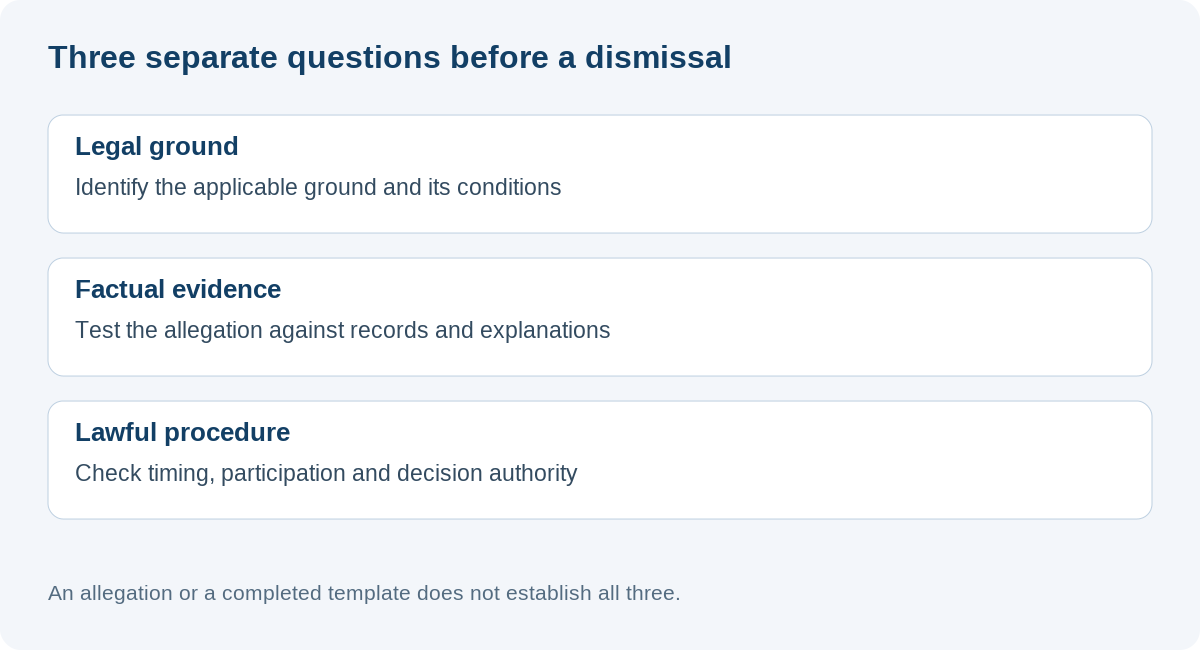
Disciplinary dismissal in Vietnam requires an applicable legal ground, reliable evidence and the prescribed process. Review the rules, protected periods and hearing records before issuing a decision.
Lawful disciplinary dismissal in Vietnam requires a valid legal ground, evidence of the employee's fault and the prescribed disciplinary process. An employer's wish to end a difficult working relationship does not establish those requirements. Before communicating a decision, the responsible team should identify the proposed legal route, review the incident record and determine whether dismissal is available in the particular circumstances.
Disciplinary dismissal is different from termination for poor performance, redundancy or an agreed separation. These routes answer different questions and cannot be exchanged simply because one seems quicker. Start by describing what actually happened and why the employer believes it matters. The legal assessment should follow those facts, rather than begin with a decision to dismiss and search afterwards for a supporting label.
Review the employment relationship alongside the workplace rules and earlier disciplinary records. The guide to a labour contract in Vietnam explains the broader contractual context. For an incident, however, the team needs a separate file showing the alleged conduct, the rule relied upon and the procedure followed. A general termination clause does not resolve all of those questions.
Article 125 of the Labour Code sets out the dismissal grounds. Assess the relevant category and its conditions individually. A disciplinary recurrence concerns repetition during an uncleared qualifying sanction; it is not a rule about repeating a criminal conviction. Alleged misconduct also needs evidence connecting the employee to the conduct, rather than a conclusion based only on job title or access to a location.
A description such as “untrustworthy” does not identify the action in dispute. Record the date, conduct, relevant duty and source of the information. Distinguish a direct observation from an account supplied by somebody else. If a document has been interpreted in more than one way, preserve the original and record the competing explanations. The purpose is to make the issue examinable, without presenting an untested allegation as an established finding.
For information-related incidents, identify the material, access arrangements and alleged disclosure. For property incidents, examine custody and handover records. The fact that a loss occurred does not identify who caused it. A useful file records what is known, what remains uncertain and which additional information could change the assessment. Gaps should remain visible rather than disappear into a strongly worded management summary.
For the absence ground, Article 125 uses five accumulated days within 30 days or twenty accumulated days within 365 days, beginning with the first unauthorised absence. “Five days in a calendar month” is therefore misleading shorthand. The employee's explanation and any legitimate reason also require assessment. A payroll total alone may not establish which scheduled days were missed or how the relevant period was calculated.
Suppose a supervisor identifies several absences near the end of one month and others near the start of the next. The person reviewing the case should reconstruct the scheduled work and actual attendance, rather than separate the entries into two calendar-month totals. They should also collect leave requests, communications and supporting documents. This exercise identifies the questions to assess; it does not predetermine that the employee can be dismissed.
A spreadsheet should show each date, source record and disputed entry. If the employee says a supervisor authorised leave, obtain the relevant communication and clarify the supervisor's role. Do not silently reclassify an entry to make a threshold appear satisfied. The completed chronology should be capable of explaining why particular dates were included and how contrary information was handled.
Planning lawful disciplinary dismissal in Vietnam also requires a separate timing review. Article 122 protects specified periods, including maternity leave and care of a child under twelve months; the latter protections should not simply be described as applying only to women. Article 123 generally provides six months, or twelve for specified conduct, with a qualified extension after protected periods. The longer period does not apply merely because the employer operates a business.
Record the incident date, the information relevant to any protected period and the proposed decision date. Assign someone to maintain the chronology while the evidence is collected. An internal investigation taking longer than expected does not itself establish a new statutory deadline. If dates or the applicable rule are uncertain, resolve that uncertainty before relying on a meeting invitation or draft decision.
Different restrictions need to be considered together. A manager should not assume that a period without a hearing can be replaced by informal pressure to resign. Equally, the existence of a complaint does not decide the outcome of the underlying incident. Keep the assessment focused on the applicable legal requirements and the employee's circumstances, with a clear record of the basis used for each conclusion.
Article 70 of Decree 145/2020 requires at least five working days' advance notice to the required participants. The notice needs meaningful particulars, and receipt matters. Relevant participation includes the organisation of which the employee is a member and, for an employee under fifteen, the legal representative. The former article's blanket reference to parents of every worker under eighteen was inaccurate.
Identify the allegation clearly enough for the employee to understand what will be considered. Retain the notice, the method used to send it and evidence of receipt. If somebody cannot attend, address confirmation and scheduling under the applicable procedure. Do not treat a non-response as proof of misconduct or assume that an absent participant makes every meeting either automatically valid or automatically impossible.
Prepare the evidence in an organised order and allow the employee's explanation to be considered. The meeting should not function as a presentation of an outcome that management has already irrevocably selected. If new information changes the factual picture, the responsible people need to assess its effect. A refusal to accept an explanation should have a reason tied to the record, rather than rest on the employee's disagreement with management.
A meeting record should identify the issue discussed, participants, evidence considered and the explanations given. It must distinguish a person's statement from the meeting recorder's conclusion. If the employee disputes a date or denies receiving an instruction, record that dispute accurately. Removing inconvenient comments may make the document shorter, but undermines its ability to explain the process actually followed.
The rules address minutes, signatures and recording a refusal to sign. A missing signature should not be concealed or replaced with an unsupported statement that everybody agreed. Preserve the reason given, if any, and the surrounding records. Likewise, follow the applicable conditions concerning absence instead of inventing an unconditional right to proceed whenever somebody fails to attend.
A property incident may raise both issues, but the reasoning and procedure for financial liability need their own review. Do not insert an automatic repayment demand into the dismissal decision simply because a loss is alleged. Collect the allocation, custody, valuation and incident documents relevant to that question. Keep any disputed financial issue visible when preparing final payments, rather than assuming the employer can withhold everything until it is resolved.
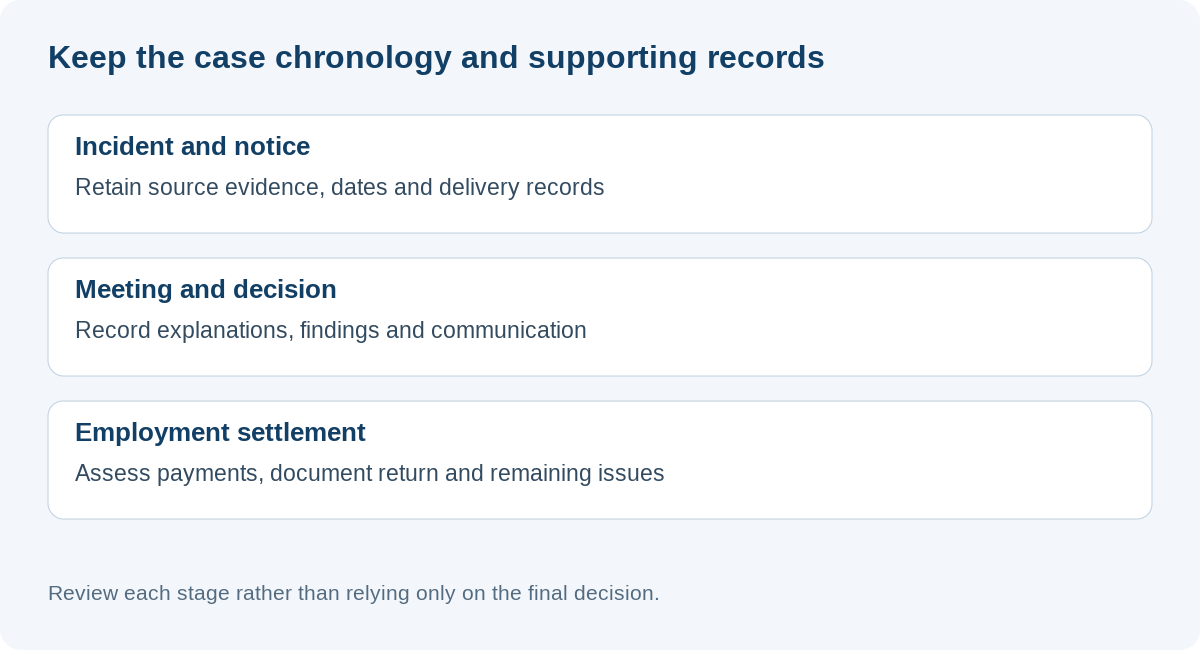
Before issuing a decision, verify the competent signatory, legal basis, factual findings and timing. Check that the document addresses the case considered at the meeting. A different allegation should not quietly replace the original one at the final stage. The record should show how the decision-maker moved from the evidence and explanations to the conclusion, including any material uncertainty that remained.
Lawful disciplinary dismissal in Vietnam cannot be established by a polished decision template alone. Compare the draft with the operative workplace rules and the documents showing the earlier process. If a required step has not been completed, identify the legal consequences and available course of action before communicating the outcome. Do not backdate notices or reconstruct a meeting as if it had occurred.
Send the decision to the persons required by the applicable procedure and retain evidence of communication. A public announcement is not a substitute for proper delivery. Access to the case file should also be limited to those with a legitimate role. Operational instructions about access cards, company devices or handover should be coordinated without turning internal communications into unnecessary allegations circulated across the workforce.
Article 48 generally requires settlement within fourteen working days after termination; specified exceptions allow up to thirty days. Salary already earned and other applicable entitlements require assessment. Insurance contribution confirmation and return of retained original documents are separate responsibilities, not a promise to refund insurance payments. Do not reuse the outdated seven-working-day statement from an older template.
The employee may dispute the basis or procedure. Preserve the case documents and examine the competent complaint or dispute route and applicable deadline. A generic instruction to approach an old department name or a former district court is insufficient. Nor should every disputed dismissal be presented as a criminal matter. The available remedy depends on the facts and legal requirements, which need their own assessment.
When discussing a case with Jurion & Partners, prepare the operative rules, incident evidence, attendance or custody records where relevant, communications, notices, meeting minutes and any decision already sent. Explain what stage has been reached. If management has announced an outcome, disclose that fact rather than asking for advice as though the case were still entirely at the investigation stage.
The practical aim of lawful disciplinary dismissal in Vietnam is a decision supported by the correct ground, reliable facts and a fair statutory process. Start with the incident rather than a preferred outcome, keep timing and participation under review, and complete the resulting employment responsibilities. A documented assessment helps both employer and employee understand what was decided and the basis on which it can be reviewed.






Subscribe today to get more breaking news from Jurion Partners - Solicitors & Litigators

108 Tran Dinh Xu St., Cau Ong Lanh Ward, Ho Chi Minh City, Vietnam
(+8428) 66.701.709 - (+84) 903.419.479
contact@jurionpartners.com
Follow us
Accept payment





 English
 Tiếng Việt