Define the scope of dismissal advice around the case stage, available evidence and decisions required. Distinguish document review, implementation and representation.
Legal advice on disciplinary dismissal should help a business understand whether the proposed action is available, what the evidence supports and which responsibilities remain unresolved. The assignment may begin before an investigation, shortly before a meeting or after a decision has already been communicated. Those situations need different work. A useful engagement identifies the stage reached and the questions requiring an answer, rather than promising to make a preferred dismissal outcome lawful.
Start with the employer's actual concern. Is there suspected misconduct, repeated poor performance, an operational change or a disagreement about working arrangements? They should not all be labelled dismissal cases. The adviser needs to distinguish the employment route before assessing what can lawfully be done. A business objective to replace an employee is not itself a disciplinary ground.
The first instruction should also say who is seeking advice and who may provide directions. A company and an individual manager can have different interests, particularly if the manager's own handling of the matter is questioned. Confirm the client and the scope before circulating sensitive documents. The engagement should not be assumed to cover personal representation of every participant in the incident.
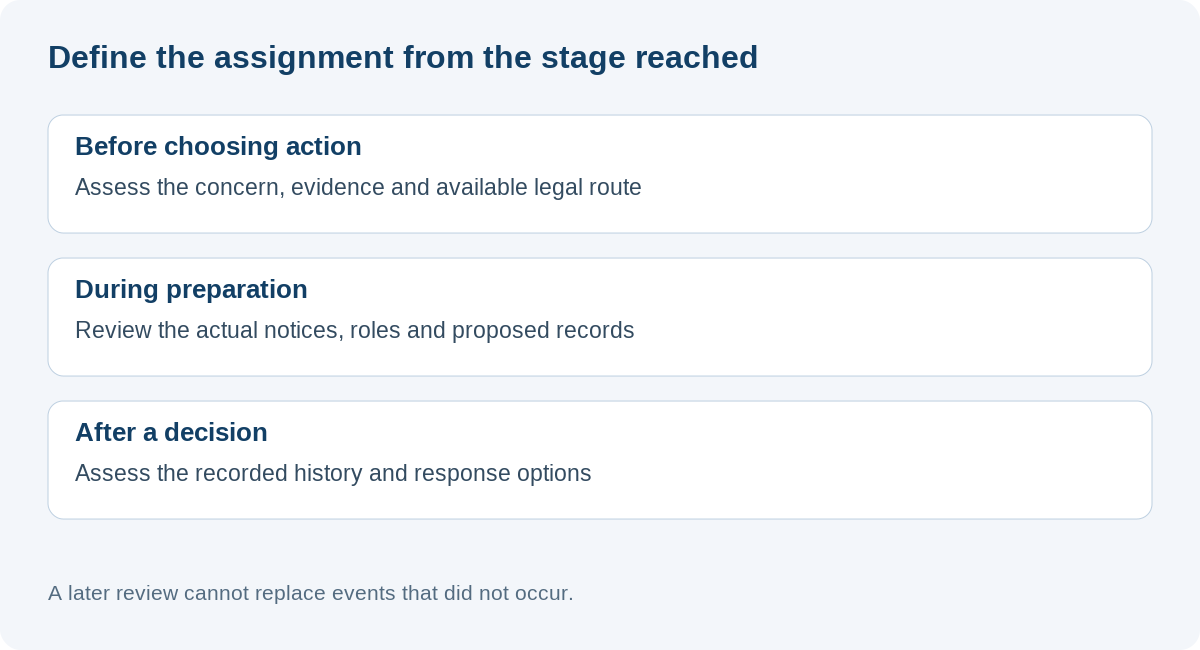
Describe the incident, what management has done, what the employee has said and the next proposed action. Identify any date already announced. If a warning, meeting notice or decision has been sent, include it in its actual form. An adviser cannot reliably assess the position from an account that omits earlier communications because the business now wishes it had handled them differently.
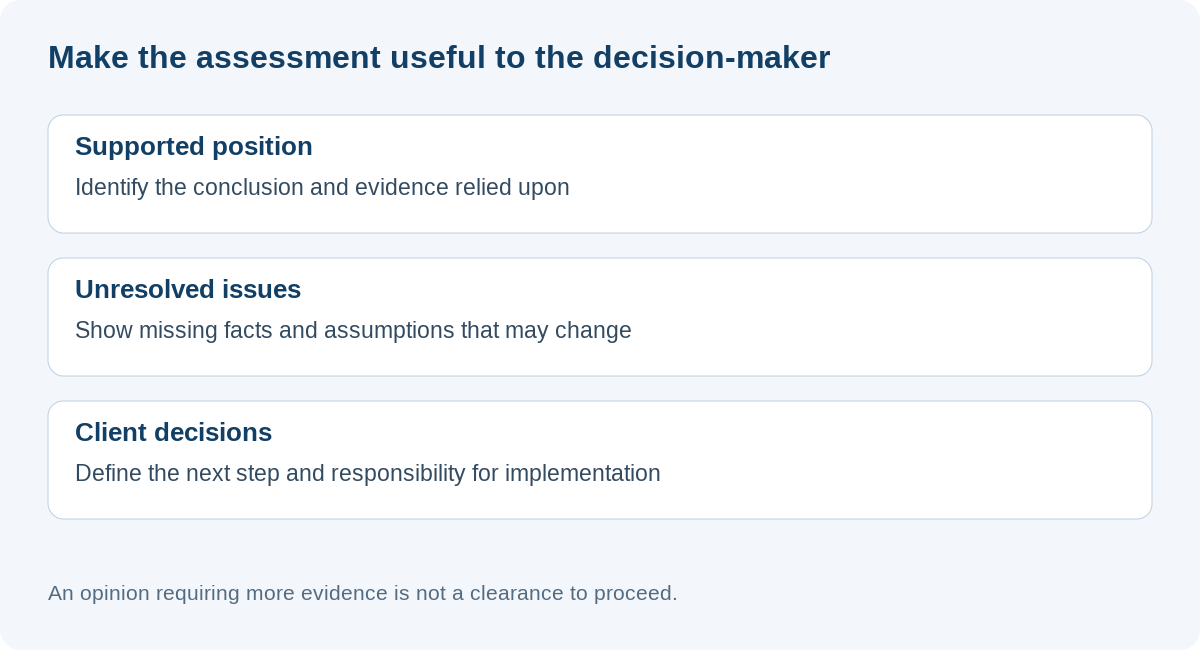
An early assessment can identify the possible legal route, the facts still needed and actions that should not be taken without further review. The result may be a focused question list or a reasoned recommendation to collect particular records. It need not be a dismissal decision. Identifying that the proposed action lacks a supported basis is an important possible result of the assignment.
The work may include reviewing the allegation, participants, timing and documents intended for use. The adviser should know whether the person preparing the file has authority to arrange the relevant steps. Support with documents is different from being instructed to attend a meeting or represent the company. Define those tasks separately so that responsibility for the actual process is understood.
The review must address what occurred, not describe an ideal procedure as if it could be substituted retrospectively. Preserve the decision, delivery records, minutes and the employee's response. The adviser may need to assess potential defects, outstanding employment obligations and the available response to a complaint or dispute. A fresh document cannot erase the history of a decision already sent.
Legal advice on disciplinary dismissal is more useful when the source material can be checked. Keep original records alongside the chronology. A summary can explain how documents fit together, but should not replace them. Where a witness did not observe an event directly, identify the source of their account. Where a record has been corrected, retain enough information to understand the correction.
The list is a practical starting point for a review, not a universal filing requirement. The adviser should explain which additional information matters and why. Sending an entire personnel archive without identifying the question may delay understanding while exposing information irrelevant to the task. Limit circulation and access according to the nature of the records.
The Labour Code treats the legal ground, proof of fault and disciplinary process as separate requirements. The analysis should explain which issue is supported and which is unresolved. A workplace rule naming dismissal does not by itself establish every statutory condition. Equally, a serious incident does not remove the need to assess how the employer has handled the case.
An attendance record may be reliable while the explanation for absence remains disputed. A notice may have clear wording while its receipt has not been established. The advice should show these distinctions instead of assigning one reassuring conclusion to the whole file. Management then knows whether it needs a factual clarification, a procedural assessment or a decision about a different employment route.
Relevant restrictions and deadlines should be addressed against the employee's circumstances and the actual chronology. A conclusion based on an assumed date needs to say so. If new information appears, the person instructing the adviser should ask whether the assessment changes. An earlier opinion should not continue circulating as an unconditional confirmation after its factual basis has changed.
The business may need an initial assessment, a document review, preparation for a meeting or assistance responding to a complaint. Specify the output for each task. A draft with tracked changes serves a different purpose from a written analysis of the available options. If the user needs to decide between alternatives, a clean replacement document alone may hide the reasoning they need to understand.
| Assignment | Useful output |
|---|---|
| Initial case assessment | Issues, supporting records, missing facts and possible next steps |
| Review of proposed documents | Comments tied to the actual version and questions requiring confirmation |
| Review after a decision | Assessment of the recorded process, outstanding duties and response options |
Agree who will receive the result and how unanswered questions will be handled. A note saying that more evidence is required is not a clearance to proceed. Nor does advice to revise a document establish that the revised version has been reviewed if management later changes it again. The handover should make the status of the work understandable.
A supervisor asks for a dismissal letter after several missed shifts. Human resources holds attendance data, while the employee says leave was discussed with another manager. The initial service should establish the relevant dates, communications and work schedule, then assess the proposed ground and process. Drafting the requested letter before resolving those questions would not answer whether the action is available.
The adviser may ask for the leave exchange and a reliable chronology. If management cannot locate a communication, that uncertainty must remain visible. The result might identify further evidence needed or conclude that a different response requires consideration. This example illustrates how the instruction develops; it does not assume either that the employee's account is correct or that the employer can dismiss.
In another case, a business has delivered a disciplinary decision and then receives an objection about the meeting. It should preserve what was sent, who received it and the documents showing attendance and explanations. The assignment is now a review of an existing act and a response to the objection, rather than preparation of a future meeting as though nothing has occurred.
Legal advice on disciplinary dismissal at this stage should identify the facts needed to understand the complaint, the scope of any potential defect and the choices requiring further assessment. Management should not ask staff to recreate a missing record with an earlier date. The appropriate response must be considered from the true history and current position, including obligations that continue while the dispute is assessed.
Reviewing a decision is different from managing payroll, confirming insurance records or collecting company property. The engagement should identify which employment consequences are being assessed and who implements the result. Do not describe insurance responsibilities as simply paying the employee's insurance back. Likewise, an unresolved property issue does not establish an unrestricted right to withhold everything owed.
For the broader employment relationship, consult the guide to a labour contract in Vietnam. In the particular case, maintain a separate list of outstanding payments, document responsibilities and disputed items. Each should have a responsible person and a basis for its treatment, rather than disappear into a general statement that dismissal ends all obligations.
Advice on a complaint does not automatically include negotiations, representation before an authority or court proceedings. Identify the intended task, authority to act, documents required and costs before extending the engagement. Article 131 recognises complaint and dispute routes; choosing the appropriate route and deadline needs a case-specific assessment. A service description should not promise success or a fixed resolution time regardless of the dispute.
Where settlement is considered, the parties need to understand the proposed terms and their legal implications. An employee's signature should not be treated as a universal answer to every earlier defect. Nor should management assume that seeking advice means the matter must be contested. The appropriate recommendation depends on the facts, available lawful options and the client's informed instructions.
When discussing an engagement with Jurion & Partners, identify the stage reached, the next date that matters and the documents already communicated. Explain what decision management needs to make. This helps define an assignment that addresses the real difficulty, instead of commissioning a standard document while the underlying problem remains unresolved.
>>> Read more: Labour contract in Vietnam
>>> Read more: Procedures for getting a work permit for foreigners
Effective legal advice on disciplinary dismissal connects a defined question with evidence, legal analysis and a usable next step. State what has happened, preserve contrary information and clarify who makes and implements the decision. The value of the service is a supported assessment of the actual case, including when the requested action cannot responsibly be recommended.






Subscribe today to get more breaking news from Jurion Partners - Solicitors & Litigators

108 Tran Dinh Xu St., Cau Ong Lanh Ward, Ho Chi Minh City, Vietnam
(+8428) 66.701.709 - (+84) 903.419.479
contact@jurionpartners.com
Follow us
Accept payment





 English
 Tiếng Việt