Draft internal labour regulations that reflect actual workplace arrangements, distinguish lawful disciplinary rules from management preferences, and follow the applicable consultation, registration and communication process.
Drafting internal labor regulations requires more than collecting rules that management would like employees to follow. The document needs to reflect the actual workplace, distinguish misconduct from other employment issues and fit the legal process for adoption and use. A useful drafting project therefore starts with how work is organised, then connects each proposed provision to an identifiable responsibility and a workable implementation plan.
Identify the employing entity, workforce, locations and working arrangements. A group may use several companies, while a single employer may operate an office, warehouse and customer-facing team. Those facts affect the questions the drafter must ask. A rule designed around office attendance may be difficult to apply to employees who travel, work shifts or perform their duties at customer premises.
Collect the existing rules, employment documents, relevant collective arrangements and earlier adoption or registration records. Ask which version managers currently use and which provisions have caused uncertainty. If the status of a document is unclear, record that as an issue to resolve. Reformatting an old document does not establish that its substance or implementation process remains suitable.
Instead of asking for a standard policy, describe recurring situations. Are attendance reports incomplete? Do employees share access to equipment? Is responsibility for receiving a workplace complaint unclear? These facts help the drafter identify the underlying need. They also reveal operational weaknesses that a clause alone cannot fix, such as a missing handover record or inconsistent instructions from supervisors.
The Labour Code No. 45/2019/QH14, as amended, is the starting framework. Employers with at least ten employees need written internal regulations and registration. The document is different from an individual employment contract, a performance assessment scheme or a technical manual. Treating all these materials as interchangeable can leave employees uncertain about which obligation applies and how a concern will be handled.
A contract records individual terms, while operational instructions may explain how a task is performed. Internal regulations address the workplace framework within their proper legal scope. Review the guide to a labour contract in Vietnam when aligning individual terms with the wider policy set. Consistency means resolving contradictions, rather than inserting a general statement that every company policy automatically overrides the contract.
Article 118 identifies subjects including working time and rest, workplace order, safety, sexual harassment prevention and handling, protection of assets and information, temporary work reassignment, misconduct and sanctions, material liability and disciplinary authority. A content map helps the drafting team locate these subjects and identify where workplace facts are still missing. Copying the headings without developing the relevant provisions leaves much of the task unfinished.
For working arrangements, ask who maintains schedules and how changes reach employees. For equipment, identify the handover record and the person receiving returned items. For information protection, examine how access is granted and removed. These questions do not decide whether a particular sanction is lawful; they make the proposed obligation understandable and reveal what the employer would need to know if a concern arose.
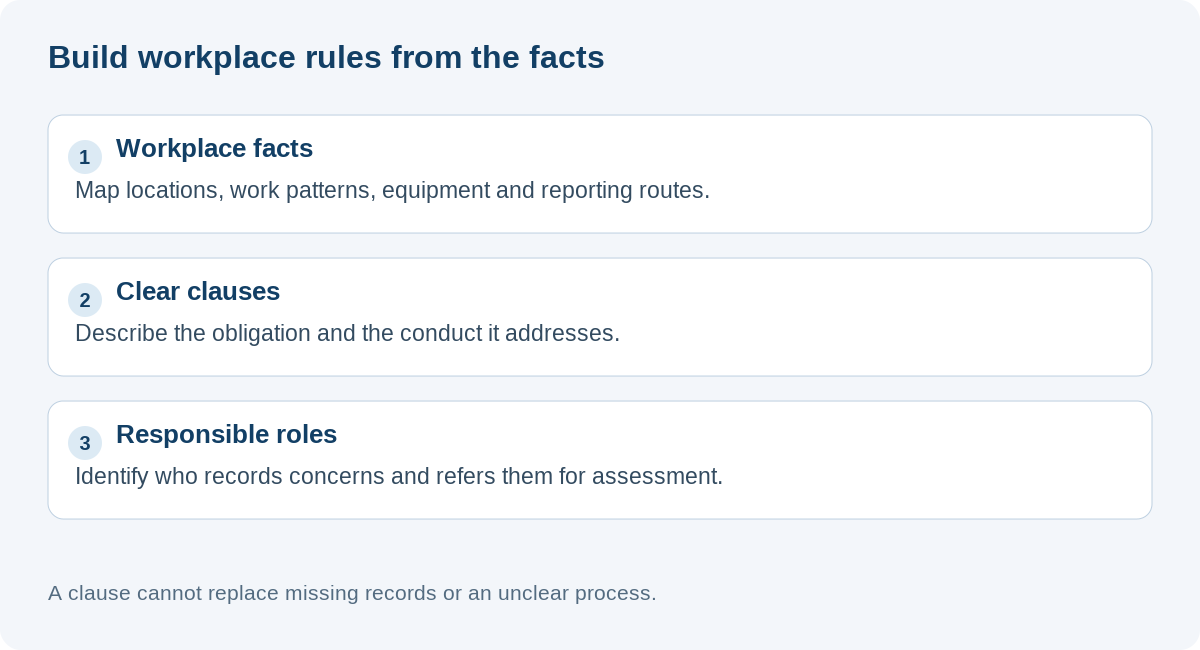
When drafting internal labor regulations, avoid relying on labels such as “bad attitude” or “failure to meet expectations” without explaining the conduct in question. A manager and an employee may understand those expressions differently. Consider whether a provision identifies an action, a relevant obligation and the circumstances in which it applies. Examples can clarify the rule, but should not quietly expand it beyond the operative wording.
A clause referring to an unspecified instruction creates a practical problem if employees cannot identify that instruction. Check references to procedures and supporting documents, including their availability and version. Some technical details may belong in a separate manual, but the relationship between that manual and the workplace rules needs deliberate review. A general reference to whatever management may announce later is a poor substitute for clear drafting.
For a multilingual workforce, plan how the meaning will be communicated consistently. Different language versions should not give employees conflicting directions. Translation requires more than matching a heading: the people reviewing the documents need to check obligations, exceptions and terminology. Any uncertainty about the governing text or the status of a translated version should be resolved before implementation.
A statement that harassment is unacceptable does not explain where a concern can be raised or how it will be received. The drafting exercise should examine the reporting route, the responsibilities of those handling the matter and the safeguards needed for the people involved. Consider what happens if the usual recipient is implicated or unavailable, rather than assuming every concern can pass through a line manager.
Keep the wording aligned with the applicable legal requirements for prevention and handling. The accompanying process should explain access to records, referral for assessment and appropriate communication. An allegation needs careful handling; the existence of a report should not be presented as a completed finding. Training should help managers recognise the boundary between receiving information and deciding what response is justified.
Internal rules do not create unlimited disciplinary powers. Article 127 prohibits fines or wage cuts as substitutes for disciplinary sanctions. A listed breach also does not make dismissal automatic: the legal grounds, evidence and required procedure need their own assessment. Wording that promises an immediate penalty for any breach can mislead managers about what they are permitted to do.
Drafting internal labor regulations should distinguish a disciplinary allegation from a performance concern or a proposed contractual change. They may require different facts and processes. Likewise, material liability should not become a general obligation to reimburse every business loss. If equipment or stock is entrusted to an employee, examine the allocation, custody and return records rather than assuming a broad repayment clause resolves every question.
Implementation guidance can direct managers to preserve relevant information and refer the matter to the appropriate person. It should not encourage them to impose a preferred outcome first and build a record afterwards. A well-drafted rule supports a reasoned assessment; it does not replace that assessment. The employer should know which decisions require further legal review before anyone communicates a sanction.
Consider a warehouse where several employees use shared devices. A proposed clause says that whoever last used a device must pay for any later damage. That wording may ignore shared access, an existing defect or a missing handover record. The drafting team should first understand how custody is recorded and how damage is identified, then assess the proposed responsibility within the legal framework.
The exercise may produce several different actions: revise the relevant clause, improve the equipment log and train supervisors to record an incident accurately. It should not produce a promise that every future loss will be recoverable. Testing a rule this way exposes assumptions before employees are expected to comply with it, and distinguishes a drafting problem from an operational one.
Before issuance or amendment, Article 118 requires consultation with the workplace employee representative organisation where one exists. Consultation should be planned while the draft can still be considered, not treated as a signature to obtain after implementation. Keep the relevant comments and the version reviewed so that the preparation record can be understood later.
The registration workstream has its own documents and responsibilities. The government procedure published under Decision 628/QD-BNV identifies a registration request, the regulations, representative organisation comments where applicable and related discipline or material-liability documents if any. The employer should coordinate these records with the final text. A submission containing inconsistent versions makes the project harder to administer.
The published procedure directs filing to the provincial specialist internal-affairs agency, or a commune specialist internal-affairs agency where delegated. Do not copy the former department or district office from an old template. Confirm the applicable local arrangement and submission method for the employer. A change in administrative organisation is a reason to verify the procedure, rather than guess a replacement office name.
The procedure states submission within ten days of issuance and provides for notification and guidance on unlawful provisions within seven working days. That process should not be described as a guarantee that every submitted clause has been approved. Allocate someone to monitor the submission, retain the receipt and address any required revision or resubmission using the correct version.
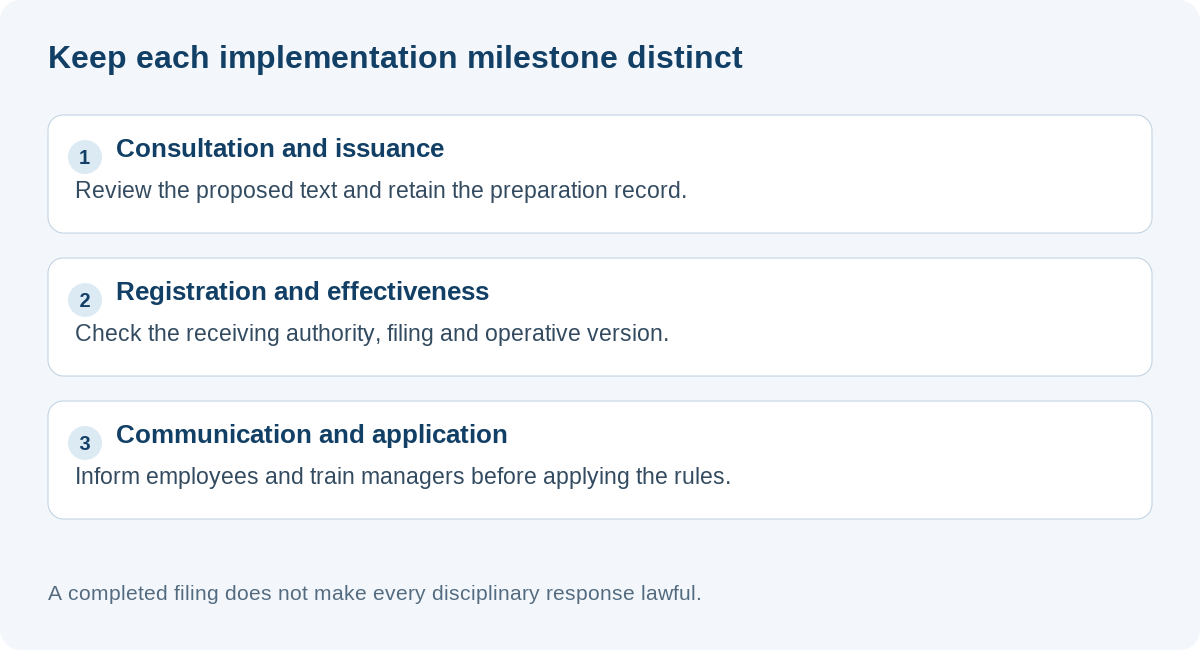
Under Article 121, regulations subject to registration take effect 15 days after the competent authority receives the complete registration dossier. Where an employer with fewer than ten employees voluntarily issues written regulations, their effective date is determined in those regulations. The project record should distinguish receipt of a complete dossier from the date documents were first sent, particularly if a revision or resubmission is required.
Record the applicable effectiveness assessment before directing managers to use the new rules. Filing, issuing and circulating a document are not interchangeable milestones. The person administering the project should be able to identify the intended operative version and the basis for its start date. If that position remains unresolved, the uncertainty should be raised rather than concealed by a date printed on the cover.
Employees need to receive the rules, with the main contents posted where required. Beyond the communication step, consider whether the intended audience can understand and find the document. A warehouse employee and an office-based manager may access information differently. Keep superseded versions out of routine use so that a previous edition does not continue circulating through personal folders or onboarding materials.
Managers need guidance on the limits of their role, not merely a copy of the policy. Use short scenarios to ask who receives a concern, what information should be recorded and when the matter must be referred. This can reveal an unclear responsibility before a real incident occurs. Training should also explain that the rules do not authorise an automatic response without considering the circumstances.
A new site, revised shift system or different approach to information access can expose gaps in the existing rules. Keep a record of proposed changes and their reasons, then review the required process before putting a revised version into use. Avoid making informal additions through a supervisor's message if the change belongs in the operative workplace framework.
An employer discussing a drafting project with Jurion & Partners can prepare its workforce profile, existing rules and a small set of actual workplace situations. Identify whether the assignment covers a new document, a revision, the adoption process or a separate incident. This allows the scope to address the real drafting need while keeping individual disciplinary decisions subject to their own review.
>>> See more: Procedures for getting a work permit for foreigners
>>> See more: Implement disciplinary action of dismissing lawfully
The aim of drafting internal labor regulations is a workplace framework that employees can understand and managers can administer within lawful boundaries. Begin with the operating facts, test the proposed clauses and complete the appropriate process before use. Then maintain the document alongside the records and training needed for consistent application.






Subscribe today to get more breaking news from Jurion Partners - Solicitors & Litigators

108 Tran Dinh Xu St., Cau Ong Lanh Ward, Ho Chi Minh City, Vietnam
(+8428) 66.701.709 - (+84) 903.419.479
contact@jurionpartners.com
Follow us
Accept payment





 English
 Tiếng Việt