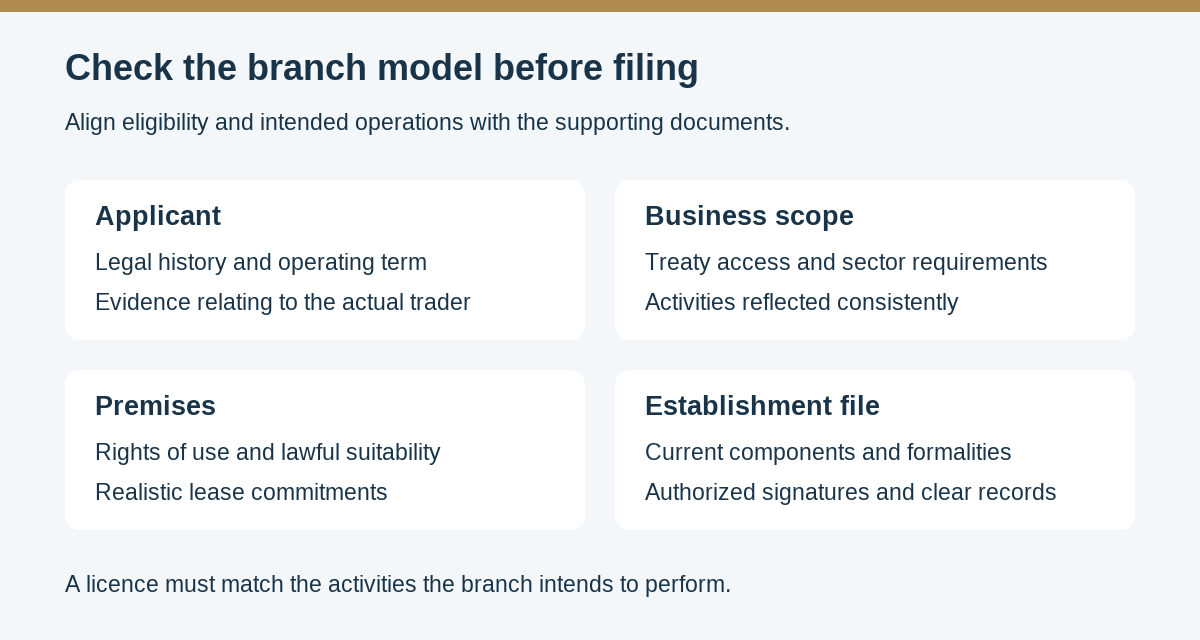
Part1 covers branch feasibility, applicant eligibility, proposed activities, current dossier components, foreign-document formalities and premises checks.
Establishing a foreign branch in Vietnam starts with a commercial question: what activities will the overseas trader actually carry out here? A branch is not simply an office address or a substitute label for a Vietnamese company. Its eligibility, proposed business scope, personnel and premises must fit the applicable legal framework. This first part explains the assessment and establishment file; ongoing management requires a separate operational review.
Begin with a description of the intended transactions, customers, revenue and local responsibilities. Distinguish direct commercial operations from market research or liaison work. A representative office and a branch do not provide identical operating rights, while a locally incorporated company raises its own establishment and governance questions.
Decree 07/2016/NĐ-CP provides the general framework for representative offices and branches of foreign traders. Where establishment in a particular industry is governed by specialized legislation, that legislation must also be assessed. Do not apply the general branch checklist automatically to banking, legal services or another sector with a distinct licensing regime.
Compare the permitted structure with the business plan before committing to a lease or recruiting a head of branch. If the proposed activity cannot lawfully be conducted through the branch, completing corporate documents will not cure that problem. A brief feasibility assessment can prevent investment in a structure that does not match the intended operations.
Article 8 requires the foreign trader to meet the relevant establishment or recognition condition concerning its home jurisdiction and Vietnam’s treaty framework. It also requires at least five years of operation from establishment or registration. Evidence should relate to the applicant itself, not merely a group affiliate with a longer trading history.
If the applicant’s registration or equivalent document specifies an operating term, at least one year must remain when the application is filed. Check the actual document and legal status rather than confusing an annual certificate’s issue date with the company’s permitted lifetime. Explain any renewal or replacement record consistently.
The proposed scope must match the foreign trader’s business lines and Vietnam’s relevant market-opening commitments. Where the specified non-conforming activity or treaty-jurisdiction situation arises, the additional approval and consultation route must be assessed. Meeting the five-year condition alone does not establish a right to conduct every activity.
Consider a fictional group that has operated overseas for twenty years but proposes a recently incorporated subsidiary as the applicant. The subsidiary’s own legal history needs assessment. A group profile may explain the commercial background, but it should not be presented as proof that the applicant has itself operated for five years.
Where mergers, name changes or legal reorganizations affect the history, assemble the relevant records and explain continuity. Do not assume either that every change restarts the period or that every successor automatically inherits all qualifications. The actual legal events and applicable rules need review.
A useful scope description identifies the services or transactions to be performed, the intended counterparties and the branch’s role. Broad phrases such as “all business activities permitted by law” do not replace analysis of the activities sought in the licence. The overseas trader’s registration, branch charter and application should tell a consistent story.
Map each activity against the applicable treaty commitment and domestic requirements. An industry classification can help organize the analysis, but a code alone does not prove that the branch form is open or that every component of a mixed service is permitted. Identify any component requiring separate authorization.
For a foreign branch in Vietnam, distinguish establishment permission from other requirements needed to operate. Tax administration, employment, premises and sector-specific permissions may still require action. Plan these as separate workstreams instead of describing the establishment licence as a universal operating approval.
Article 3 does not simply state that a trader can have only one branch anywhere in a province. Its restriction concerns more than one representative office or branch bearing the same name within one province or centrally governed city. The wording matters when checking an existing network or planning another location.
This does not mean a different name guarantees permission for another establishment. The proposed name and location still require review under the applicable rules, existing licences and actual activities. Prepare a list of the trader’s current Vietnamese establishments so that the assessment does not overlook an earlier office or branch.
Use the current application and check the rules in force when the file is submitted. The establishment dossier must be read with the applicable 2025–2026 decentralization, forms and simplification measures. Resolution 19/2026/NQ-CP includes a specific branch dossier in Appendix III; a downloaded checklist from an earlier year may not reflect every component correctly.
The branch charter remains part of that dossier. Conversely, the resolution’s current list should not be rewritten as an automatic demand for an old identity-card copy from every Vietnamese branch head. Identity information and any permitted database-based handling should be checked through the applicable procedure.
The financial-evidence category contains alternatives: audited financial statements, the specified confirmation of tax or financial obligations, or qualifying equivalent evidence from the competent authority or organization in the home jurisdiction. Do not tell every applicant that only one particular document can ever be used.
Check the relevant financial year, issuing source and information demonstrated. A marketing brochure, an unsigned management spreadsheet or an old annual report should not automatically be treated as qualifying evidence. Where the home jurisdiction issues a different kind of record, assess whether it meets the legal requirement before arranging translations.
Article 12 addresses Vietnamese translation and certification of the specified foreign documents. It separately addresses certification or consular legalization of the trader’s registration or equivalent document under the relevant Vietnamese rules. Review the particular document and any applicable exemption rather than applying the same treatment indiscriminately to every attachment.
Create a document schedule showing the issuer, language, original or copy available, required formalities and person responsible. Check names and registration details before certification. A mistranslated company name repeated through the application, appointment and charter can create avoidable inconsistencies.
Translation, certification and legalization serve different purposes. Completing one should not be assumed to satisfy the others. If a document cannot be obtained in the expected form, identify the issue early and assess a lawful alternative instead of manufacturing a substitute or silently omitting the requirement.
The file includes evidence of rights to use the proposed premises, such as the relevant memorandum, lease or other qualifying document. Check the actual address, the lessor’s authority and the location’s permitted use. A professionally presented lease does not by itself establish that the premises are suitable for the intended branch.
Article 28 requires compliance with the applicable security, order, occupational safety and other legal conditions. It also prohibits lending or subletting the branch premises. Commercial arrangements should therefore be reviewed against the intended use rather than built around an assumption that surplus space can automatically be rented out.
Consider timing and financial exposure. If the establishment assessment is incomplete, discuss appropriate contractual conditions and a realistic commencement date. A promised licence date should not be used to justify an unconditional rental commitment that the trader cannot afford to carry if approval is delayed.
The current decentralized procedure places branch establishment licensing at provincial level under the relevant framework. Confirm the receiving authority and submission channel for the proposed location. Avoid directing every applicant to the Ministry in Hanoi merely because older forms or articles used that route.
Ordinary processing periods depend on a complete, valid file; cases needing specialized consultation have an additional route. Keep submission evidence and respond to clarification requests accurately. Do not turn an administrative processing period into a guarantee covering overseas document preparation, consultation and every post-licensing task.
Under Article 9, the establishment licence has a five-year term but cannot exceed the remaining operating term shown in the foreign trader’s registration or equivalent document where that document specifies a term. A reissued licence does not automatically restart a new five-year period. Enter the actual expiry date into the compliance calendar and plan any extension through the applicable procedure.
Before proceeding, review the applicant, proposed activities, location, branch head and available evidence together. Establishing a foreign branch in Vietnam should follow a reasoned assessment of those facts, with clear responsibility for unresolved items. Keep a record of assumptions that depend on further confirmation.
A discussion with Jurion & Partners can start with the trader’s registration, intended activity description and a document inventory. Identify the specific question to resolve, such as eligibility, a mixed business scope or the suitability of a proposed location. That makes the review useful before substantial commitments are made.
The guide to legal due diligence in Vietnam explains how to organize a broader feasibility review. A well-prepared foreign branch in Vietnam begins with the correct applicant and permitted activities, then carries those conclusions consistently into the establishment file and the practical launch plan.






Subscribe today to get more breaking news from Jurion Partners - Solicitors & Litigators

108 Tran Dinh Xu St., Cau Ong Lanh Ward, Ho Chi Minh City, Vietnam
(+8428) 66.701.709 - (+84) 903.419.479
contact@jurionpartners.com
Follow us
Accept payment





 English
 Tiếng Việt