A current guide to investment registration for company formation, covering IRC applicability, company-first obligations, project evidence, authority and implementation.
An investment certificate in Vietnam should be considered as part of the project and company formation plan. The document usually intended by this expression is the Investment Registration Certificate, or IRC. It records an investment project; it is different from the Enterprise Registration Certificate, or ERC, used in company registration. Before preparing an application, determine whether the project requires an IRC, which establishment sequence is appropriate, and what the business may do before the investment procedures are complete.
The current starting point is the Law on Investment 143/2025/QH15 and its implementing framework, including Decree 96/2026/ND-CP. Article 26 distinguishes projects requiring an IRC from transactions and projects outside that requirement. Projects of foreign investors and the specified category of foreign-invested economic organisations require the relevant IRC procedure. Domestic projects and investment through capital contribution or share acquisition are treated differently.
This distinction matters when choosing between establishing a new company and investing in an existing business. A share acquisition should not be described as automatically requiring a new IRC for company formation. It may instead require assessment of acquisition registration, market access, the target's existing project records and other conditions. Classify the actual transaction rather than selecting a filing package from the investor's nationality alone.
When planning an investment certificate in Vietnam for a new project company, prepare an ownership outline, identify the investor and describe the intended operation. Where an existing Vietnamese entity will carry out the project, assess its status under the relevant statutory category. A company that already exists can still have project procedures to complete; incorporation and investment registration answer different questions.
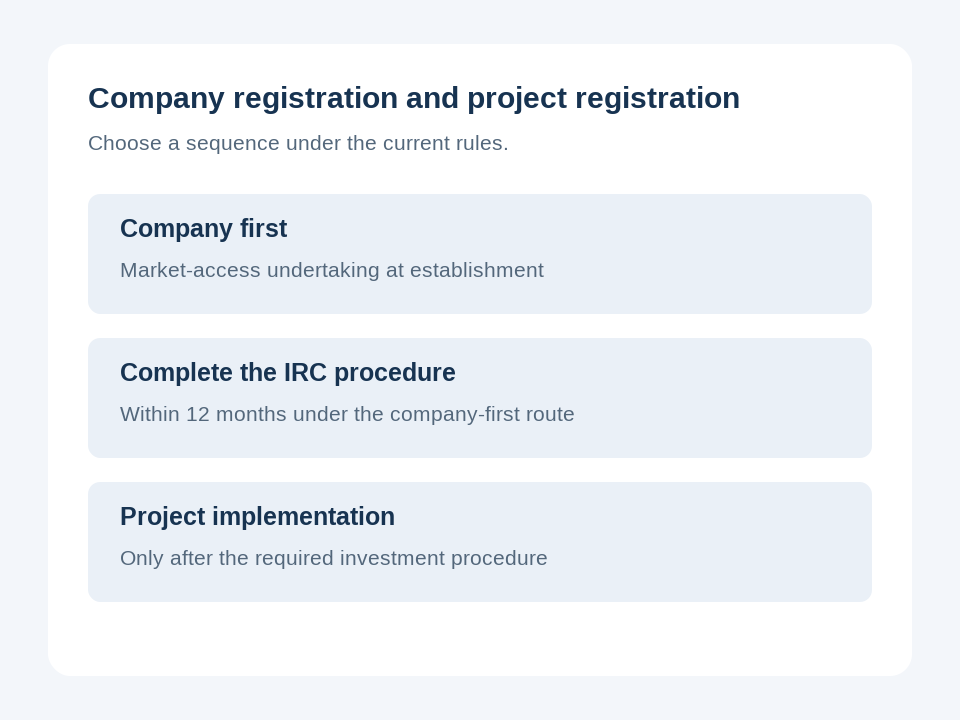
It is no longer accurate to say that every foreign investor must receive an IRC before forming the company. Article 19 permits foreign investors to establish an economic organisation before completing the IRC procedure, while requiring compliance with foreign-investor market-access conditions at establishment. Article 72 of Decree 96 addresses both the company-first and the IRC-first routes.
Under the company-first route, the enterprise registration application includes the required market-access undertaking. The newly established organisation must complete the procedure to obtain the project IRC within 12 months from establishment. It may add other investment or business lines through amendment of its enterprise registration only after obtaining the IRC, as provided by Article 72.
The 12-month period is not permission to operate the project while waiting. The organisation may implement the investment project only after completing the required IRC procedure. Plan activities, funding and commitments around that restriction. Incorporation can create a legal entity and associated obligations without making the project ready to trade or begin physical operations.
Decree 96 also recognises completing the IRC procedure before company establishment. Once established and issued its ERC or equivalent document, the organisation becomes the investor implementing the project under the IRC in accordance with Article 72. Compare the routes against the proposed business, market-access requirements, available project information and practical dependencies. Neither route should be presented as universally preferable.
Define what the company will actually do: its services or products, customers, delivery method and any regulated functions. A broad label such as “consulting” can conceal activities requiring a different analysis. Identify the proposed foreign ownership and investor nationality, then check the applicable market-access conditions, including relevant treaty commitments where they matter.
Separate market access from the conditions for carrying on a particular business. An activity may require an operating licence, professional qualification, suitable premises or other approval after establishment and investment registration. An IRC does not automatically replace these requirements. Avoid committing to a launch date before the team understands which conditions apply and who will satisfy them.
An application for an investment certificate in Vietnam needs a coherent description of the project, not a collection of attractive statements about Vietnam's economy. Relevant matters include the investor, objectives, scale, investment capital and funding approach, location, duration, implementation schedule and other information required for the particular procedure. Where environmental, technology or other specialised information is required, prepare it for the actual project.
For example, a proposed office-based service company and a manufacturing operation have different site, equipment and implementation needs. A generic proposal can obscure those differences. Ask finance and operations to review the figures and timetable so that the application reflects a plan the business can carry out. Record unresolved assumptions before submitting them as commitments.
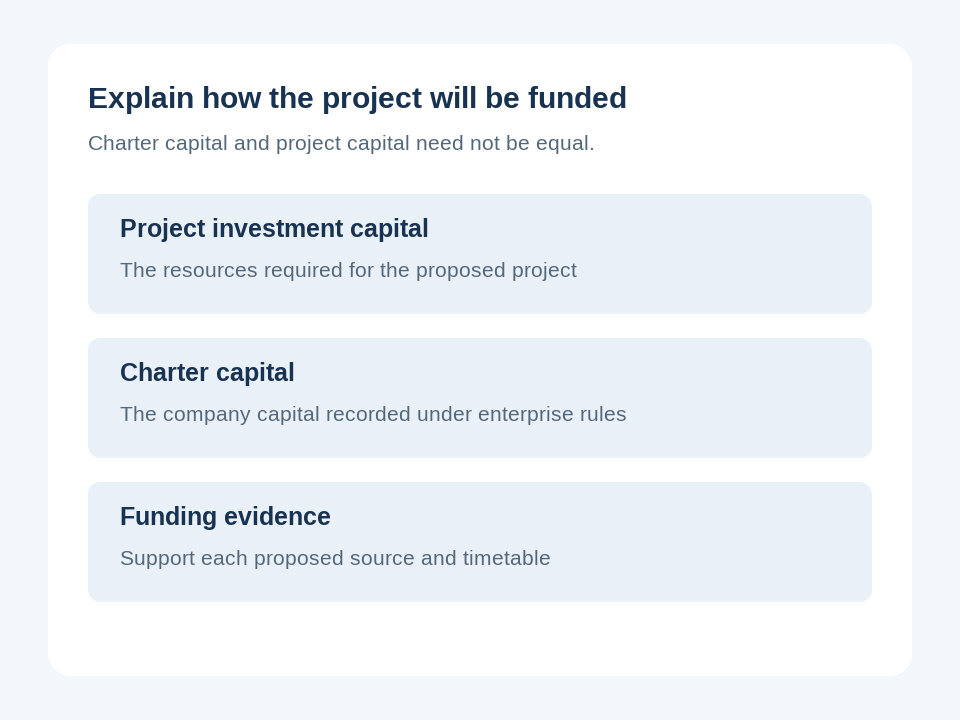
Article 72 expressly states that charter capital need not equal the project's investment capital. Explain the proposed equity and other funding sources and reconcile them with the project budget. There is no sound basis for describing every foreign-owned company as subject to one universal minimum investment amount. Any sector-specific or other applicable capital condition needs an individual assessment.
The contribution timetable, financing arrangements and any proposed borrowing also require coordination with enterprise and foreign-exchange rules. Obtaining an investment certificate in Vietnam does not resolve every banking question. Do not treat an intention to contribute capital, an internal approval and a completed transfer as the same event. Keep evidence of each stage and confirm the appropriate payment route before funds move.
The project location should be identifiable and supported by appropriate records. Depending on the case, these may include land-use documents, a valid lease arrangement or other material establishing the right to use the location. Check whether the premises suit the proposed activity and whether planning, land, construction or environmental questions affect the project. A commercial address alone does not prove that every intended use is lawful.
Financial capacity can be demonstrated through the alternatives specified by the applicable dossier rules. Article 32 of Decree 96 includes recent financial statements, a parent-company funding commitment, a financial institution's commitment, a financial-capacity guarantee or other evidence. Do not reduce that list to an assertion that every investor must provide the same audited statements. Select appropriate evidence and explain how it supports the proposed funding.
The ordinary non-policy-approval IRC route refers to the document content in Article 32(1). Relevant items include the request, investor legal-status evidence, financial-capacity material, the project proposal and applicable location or other supporting documents. Some items are conditional on the project, such as technology information or a business cooperation contract. Use the actual procedure to build the document list rather than adding every possible document indiscriminately.
Article 27 of the current Investment Law identifies the relevant management boards for projects within specified industrial and other zones, and the Department of Finance for the relevant projects outside those zones. It also addresses special location situations, including multi-province projects and projects spanning areas inside and outside zones. The old Department of Planning and Investment designation should not be copied into a current guide without checking the organisation now responsible.
First determine whether the project needs investment policy approval and any investor-selection procedure. That question is different from identifying the office that issues the IRC. A regulated or large project should not be described as requiring a generic extra approval from the former Ministry of Planning and Investment simply because of its sector. Map the precise statutory route and current authority.
For projects outside investment policy approval, Article 39 of Decree 96 provides an ordinary IRC consideration period of 10 working days from receipt of a valid dossier, subject to the stated project conditions. Those conditions address matters including the activity, location, planning and foreign-investor market access. The registration authority may seek relevant local agencies' opinions where necessary.
Article 38 provides different rules for specified approved projects and other defined situations, including five-working-day branches. Do not promise the same period for every investment certificate in Vietnam. Distinguish document preparation, any policy approval or selection stage, completion of a valid filing and the particular IRC consideration period. Requests for clarification and unresolved commercial decisions can affect the overall programme.
Maintain a controlled filing copy and submission record. Responses to questions should be checked against the entire proposal: changing an activity, funding amount or location can require corresponding revisions elsewhere. Obtain approval for substantive changes rather than selecting a convenient answer only to complete a form.
When an IRC is issued, compare the investor, project objectives, location, capital, duration and schedule with the approved application record. Identify discrepancies promptly and assess the appropriate correction or amendment procedure. Keep the operative certificate and relevant decisions together. If the IRC-first route was used, coordinate the remaining company establishment work and the project company's role.
An IRC should not be described as automatically granting tax holidays, land rights or permission for every business activity. Any incentive depends on its legal basis, conditions and the relevant tax or other procedure. The implementation team also needs to address applicable accounting, tax, employment, sector licensing, reporting and other requirements. Record the responsible person and deadline for each outstanding task.
The broader guide to procedures for foreign investment in Vietnam places the certificate work within the overall market-entry process. Use that framework when deciding what must be completed before particular activities start, and review proposed changes to the project before implementing them.
>>> Read more: Foreigners Divorce in Vietnam
>>> Read more: Custody of children in divorce disputes
A preparation discussion with Jurion & Partners can begin with the ownership structure, specific activities, proposed premises, budget and intended timing. Those facts help determine the appropriate sequence and document requirements. Advice should identify the remaining decisions and risks without guaranteeing an approval or presenting registration as the end of compliance work.
Preparing an investment certificate in Vietnam therefore starts with a project that is legally classified and commercially coherent. Confirm the required route, align the company and project records, assemble evidence for the actual proposal and plan the remaining conditions for implementation. This gives investors a clearer formation process and a more reliable basis for putting the business plan into operation.






Subscribe today to get more breaking news from Jurion Partners - Solicitors & Litigators

108 Tran Dinh Xu St., Cau Ong Lanh Ward, Ho Chi Minh City, Vietnam
(+8428) 66.701.709 - (+84) 903.419.479
contact@jurionpartners.com
Follow us
Accept payment





 English
 Tiếng Việt