For foreign-invested enterprises, when being granted investment license, the project duration shall be fixed by a certain time point from the date the certificate is granted.
Investment project extension requires a clear account of which date needs to change and why. A business may wish to continue operating beyond its recorded project duration, revise an implementation milestone or renew a separate permission supporting its activities. These are different questions. Before preparing an application, identify the relevant document, the proposed change and the current condition of the project. Treating every request as renewal of an investment licence can obscure the actual procedure and leave important obligations unexamined.
Collect the investment registration certificate, relevant approvals and every amendment. Do not assume the newest-looking document contains the complete history. An amendment may change only specified information, leaving earlier provisions relevant. Prepare a timeline showing the source of each date, the event to which it relates and any subsequent change. This gives the project team a common record before it discusses a new timetable.
Investment project extension should also be distinguished from a change to the enterprise itself. An enterprise registration document does not necessarily describe the operating duration of each project undertaken by that entity. Similarly, extending a lease is not the same as securing an investment decision. The business should identify the legal and contractual basis of each activity rather than treat the company, project and premises as one interchangeable registration.
The recorded duration of a project concerns its operating period under the applicable framework. An implementation schedule concerns the steps needed to deliver it, such as arranging capital, constructing facilities or starting a phase of production. A project can have substantial operating time remaining while already being late against a construction milestone. Conversely, an established operation may be approaching the end of its project duration despite having met its implementation schedule.
Review the premises, land arrangements and sector permissions alongside the investment documents. Each may have its own conditions and validity period. A proposed investment change does not automatically extend a landlord's contractual commitment or replace a separate regulatory process. The review should identify dependencies so that the team does not obtain one result while another necessary arrangement remains unresolved.
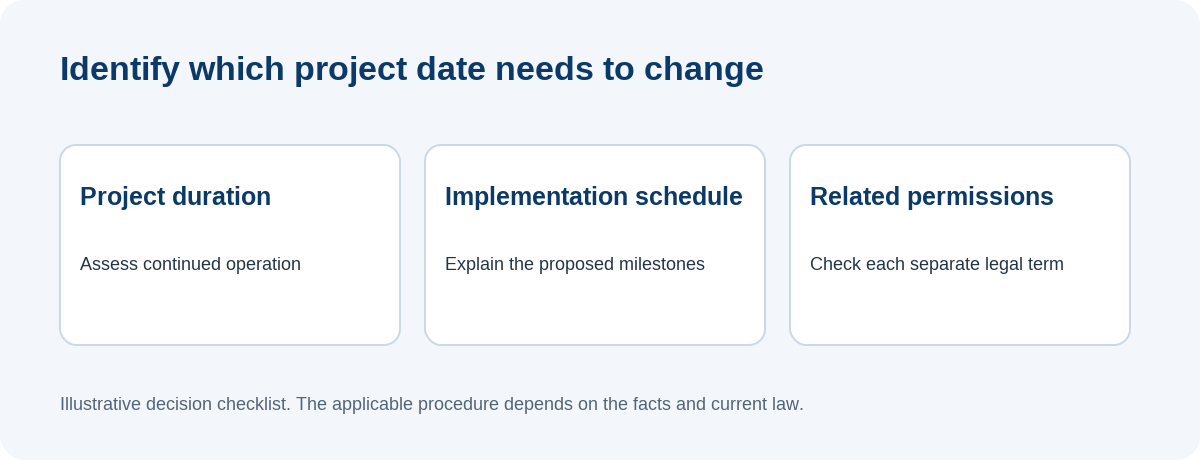
For a review in 2026, consider the Investment Law No. 143/2025/QH15, Decree No. 96/2026/ND-CP and other applicable requirements. A project approved under an earlier framework may also require a transitional analysis. Its approval date, history and proposed change matter. Do not simply replace the law cited in an old checklist and assume that the underlying procedure remains suitable.
The review should explain which issue is being assessed: continuation of the operating term, a revised schedule, an update to recorded information or another amendment. Where more than one issue exists, determine how the procedures relate. Combining requests for convenience is not a reason to overlook a required assessment. Equally, avoid creating unnecessary applications without checking whether a particular circumstance has its own treatment under the current rules.
A delay involving allocation or delivery of land is not interchangeable with a delay caused by unavailable investor funding. Current guidance addresses particular land-related circumstances and transitional cases. The business should assemble the relevant decisions, correspondence and dates before drawing a conclusion. A statement that the project has been delayed for a certain number of months does not, on its own, identify the rule that applies.
An investment project extension review benefits from a report that separates approved commitments from actual implementation. Describe what has been completed, what remains outstanding and which assumptions have changed. Include relevant compliance correspondence or inspection findings. Omitting an unresolved issue because it appears unrelated to the requested date can leave the review incomplete and make later explanations inconsistent.
| Workstream | Question to answer | Supporting record |
|---|---|---|
| Approvals | Which terms currently apply and what change is proposed? | Original approvals and amendments |
| Implementation | What has happened against the recorded milestones? | Progress reports, contracts and completion records |
| Premises | Can the location support the proposed period and activity? | Land records, lease documents and relevant permissions |
| Resources | How will the next phase be funded and delivered? | Financial evidence and an implementation plan |
Keep the report specific. If equipment was delivered, identify the supporting evidence and its relevance to the milestone. If work has not started, explain the circumstances without presenting an assumption as a confirmed cause. The purpose is to create a record that can be assessed, not to describe every aspect of the business in promotional language. Unverified information should remain clearly marked for further investigation.
Assess whether the location can support the intended next phase. A lease that expires before the proposed project period needs attention even if the commercial relationship with the landlord is good. Review permitted use, relevant commitments and any outstanding conditions. The project team should know which matters have been confirmed and which depend on a future agreement or decision.
Financial planning needs similar discipline. Distinguish existing capital, proposed additional funding and amounts that remain subject to approval. Evidence should be selected for the procedure and the investor's circumstances. Do not assume that one historical financial statement answers every question about future resources. The legal, finance and project teams need to reconcile their figures before those figures enter the application.
Identify dependencies rather than proposing a single optimistic completion date. For example, an equipment order may depend on financing, premises readiness and a technical specification that has not yet been settled. Explain who owns each task and what confirms completion. This provides a more useful basis for assessing the proposed timetable than simply adding another year to every date in the previous submission.
Investment project extension does not have one universal document list for every project. Check the currently published procedure, the competent authority and the requirements relevant to the proposed change. The application may require investment documents, a request, implementation information and evidence addressing specified conditions. Additional issues concerning land, technology or sector activities must be assessed where relevant.
Avoid relying on an old instruction to prepare a fixed number of notarised copies for all cases. Electronic submission, authentication, translations and document presentation should be checked against the applicable route. Record which documents are required, which explain a specific issue and which remain unavailable. This prevents an extensive collection of papers from being mistaken for a complete and coherent application.
The project's location, existing approvals and the allocation of authority may matter. Confirm the current receiving body and its scope before filing. An agency name appearing on an older certificate does not necessarily identify the body that now processes the request. If the project has several relevant decisions, establish which of them need attention instead of assuming that updating one certificate resolves the entire record.
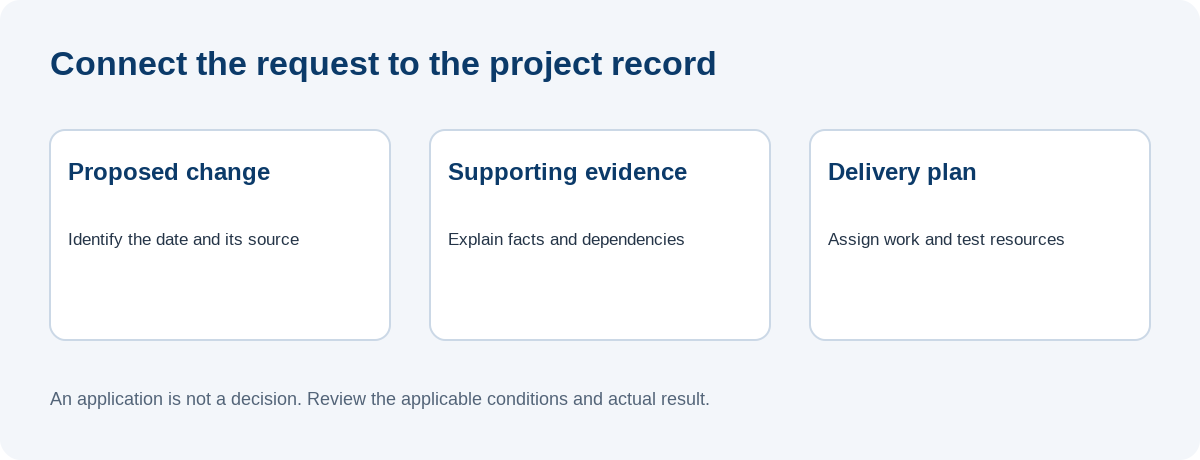
For an investment project extension, retain a complete copy of the material submitted and the receipt or acknowledgement. Submission should not be treated as approval or as automatic permission to continue every activity. The business needs a separate assessment of its position while the application is under consideration, particularly where an existing term or related permission is approaching expiry.
If clarification is requested, list the questions and assign responsibility for the relevant facts. A revised schedule can affect financial projections, premises arrangements and explanations elsewhere in the dossier. Review the connected documents rather than correcting only the paragraph mentioned in the notice. Keep a version log so that the signed documents and the submitted files reflect the same approved information.
When a decision or amended document is issued, compare its actual wording with the request. Identify which terms changed, which remained unchanged and whether further work is required. Do not tell operating teams that the entire project has been renewed if the result addresses only a particular item. Hand over the document together with a clear explanation of the actions and dates that need monitoring.
Check related contracts and permissions separately. A landlord, lender or customer may need information or a contractual update, but the investment result does not automatically amend their documents. Preserve the earlier record as well as the new result. A future review may need to understand how a particular condition evolved, and discarding the history can make that exercise unnecessarily difficult.
Prepare the document timeline, a factual progress report, the proposed change and the questions that remain unresolved before discussing assistance with Jurion & Partners. Agree whether the work covers eligibility, drafting, submission support or a separate review of premises and sector requirements. Clear scope is more useful than a general promise that a certificate will be renewed quickly.
The broader guide to foreign investment procedures in Vietnam provides context for the company's project records and continuing obligations. Use that context to organise the review, while keeping the requested amendment specific to the existing project's history and condition.
Investment project extension should be approached as an assessment of the proposed continuation, its conditions and its supporting record. Identify the relevant dates early, explain the facts accurately and check the result against the business's actual needs. A disciplined review gives the team a clearer basis for managing the next phase without assuming that a pending request guarantees the right to proceed.






Subscribe today to get more breaking news from Jurion Partners - Solicitors & Litigators

108 Tran Dinh Xu St., Cau Ong Lanh Ward, Ho Chi Minh City, Vietnam
(+8428) 66.701.709 - (+84) 903.419.479
contact@jurionpartners.com
Follow us
Accept payment





 English
 Tiếng Việt