Cross-border mergers and acquisitions (M&A) are becoming more common in Vietnam as businesses seek growth, technology transfer, and global market access.
Cross-border M&A can give an investor access to an established Vietnamese business, but the value of that access depends on what can lawfully continue after completion. Customers, employees, technology and premises may already be in place; ownership restrictions, contract consents and unresolved obligations may still prevent the buyer from using them as expected. A useful assessment therefore connects the commercial reason for buying with the legal conditions for operating the business afterwards.
This article considers acquisitions involving a Vietnamese target and an overseas investor. It separates potential advantages from assumptions that require verification, then explains how to turn identified risks into decisions about structure, price and completion. An attractive market opportunity should survive this examination before the parties commit substantial funds.
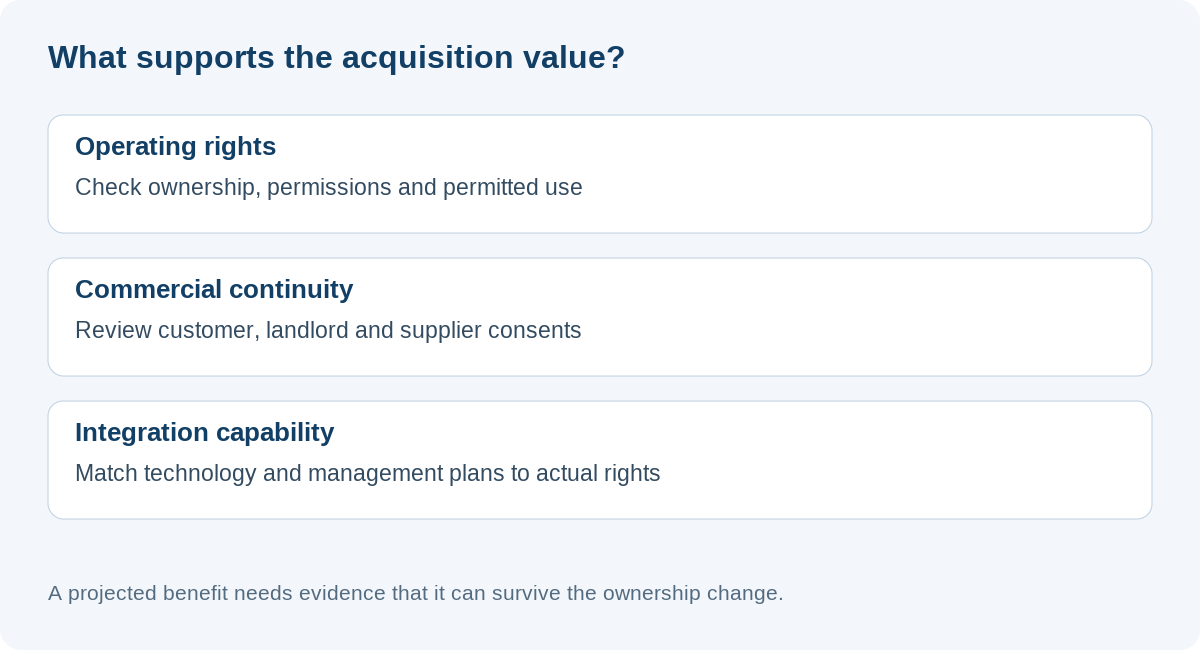
Buying an operating company can preserve a trading history, a trained team and relationships that would take time to build through a new establishment. The legal advantage is continuity within the existing organisation. That continuity has value only where the underlying rights remain effective and the change of ownership does not trigger termination, consent or renegotiation rights.
A manufacturer may have functioning production lines and a customer qualification record. A service company may have experienced personnel and contracts with recurring revenue. Rather than treating these as a single package called goodwill, the buyer should identify the evidence supporting each component: equipment ownership, customer acceptance, employment arrangements and rights to use the premises.
A share acquisition can leave the contracting company in place. It does not prove that every customer or landlord must accept the new ownership without further steps. Reviewing change-of-control provisions before agreeing the valuation helps distinguish durable revenue from revenue that depends on a third party's approval.
An investor may contribute software, technical processes or distribution expertise that improves the target's existing operations. The integration plan should identify who owns the relevant technology, which entity may use it and whether the intended users fall within existing licences. Acquiring shares in a company does not establish that its founders personally assigned every relevant intellectual property right to it.
The same discipline applies to management. A new reporting system can improve oversight, but it needs agreed decision-making authority and access to reliable records. These arrangements belong in the transaction plan rather than being left to informal discussions after the purchase price has been paid.
In cross-border M&A, the expression “buying the business” can conceal materially different transactions. Buying existing shares pays the selling owner; subscribing for newly issued equity provides capital to the company. An asset acquisition instead requires the parties to identify what transfers and how each transfer will be implemented. A statutory merger involves another set of corporate consequences.
Consider an investor seeking a distribution network together with working capital for expansion. A purchase of the founder's shares alone may change ownership without providing the target with expansion funds. A combined subscription and share purchase might better match the commercial objective, subject to the applicable legal requirements and existing owners' rights. The funding model and ownership model should therefore be reviewed together.
Neither an asset purchase nor a share purchase is inherently a complete solution to historical risk. The buyer should examine the obligations associated with the chosen structure, the consents required and the practical cost of moving operations. A lower headline price can be outweighed by a long interruption to customer service or an inability to use essential premises.
Vietnam's Law on Investment 143/2025/QH15 is the current statutory starting point for this review. Article 21 addresses foreign participation conditions and acquisition registration triggers, including specified ownership changes, conditional market-access activities and sensitive land locations. Article 26 distinguishes equity acquisitions from projects requiring an investment registration certificate. A share purchase should therefore not automatically be described as an application for a new project certificate.
The practical task is to map the target's actual activities, proposed ownership and land interests against the applicable requirements. Registration information alone may not reveal every activity carried out in practice. A business described commercially as a technology platform might also perform regulated services that need separate analysis.
For the wider investment framework, consult the guide to foreign investment procedures in Vietnam. The acquisition review should then record the particular conditions affecting this target, who will prepare each submission and what evidence is needed before the parties can complete.
An investment registration analysis does not dispose of every other regulatory question. Sector-specific permissions, competition review and corporate approvals need their own assessment where relevant. The parties should use a combined timetable, but avoid assuming that clearance on one workstream satisfies another.
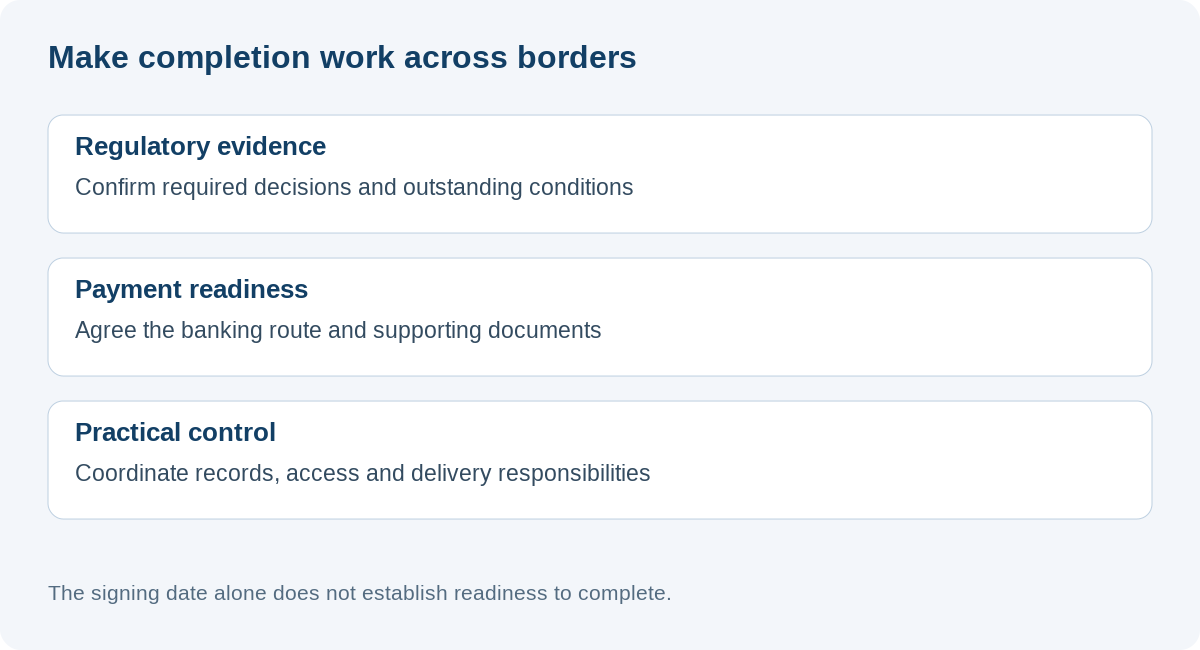
Before relying on a fixed completion date, identify which steps are within the parties' control and which depend on an authority or third party. The contract can then address delay, cooperation and a final date for reconsidering the transaction. A timetable based only on document-signing dates gives little protection against an unresolved operating restriction.
Legal due diligence in cross-border M&A should produce a decision about each material finding. A list of missing documents is less useful than an explanation of whether the missing evidence affects ownership, revenue, operational continuity or the ability to recover a loss. Request supporting records and compare them with what management says the business actually does.
Tax review should be coordinated with financial advisers so that reported earnings, outstanding obligations and the proposed price use consistent assumptions. An acquisition does not by itself establish a new entitlement to tax incentives. Where the valuation relies on an incentive or exemption, verify its basis, remaining duration and continued eligibility under the proposed operating arrangements.
Identify which entity and which period a potential liability concerns. Historical company obligations and a seller's contractual promise to compensate the buyer are different matters. The buyer also needs to assess the evidence required to bring a claim and the seller's practical ability to meet it.
Ask what would happen if a key manager left, a landlord refused consent or a major customer reduced its orders. Each scenario tests a different assumption behind the purchase price. Employment records, property documentation and customer agreements should be examined alongside the integration plan, rather than reviewed as unrelated folders.
For example, a factory may depend on both a lease and an equipment maintenance arrangement with a founder-controlled company. The acquisition contract should identify the required continuing arrangements, their commercial terms and the evidence of authority to sign them. A promise that the founder will “help with the transition” is too uncertain to replace those documents.
A cross-border M&A completion needs a workable funds-flow plan. Identify the payer, recipient, currency, banking route, supporting documents and the point at which each party must release funds or deliver evidence. Confirm the proposed route with the banks involved and the relevant advisers before incorporating it into the contract.
Do not assume that one account arrangement works for every ownership structure or every type of payment. Acquisition consideration, a capital contribution and a shareholder loan serve different purposes. The completion documents should use descriptions consistent with the approved structure and the actual movement of money.
Document execution also deserves an early test. Determine which overseas signatories need corporate authorisations and which documents require translation, certification or other formalities for their intended use. Keep a version register so that the signed contract, disclosure materials and completion checklist refer to the same transaction.
In cross-border M&A, a detailed contract helps only if its mechanisms correspond to the findings. A missing essential consent may justify a completion condition. Uncertain financial performance may require an agreed price mechanism. A defined historical exposure may need a specific compensation arrangement supported by a realistic recovery route.
These mechanisms involve commercial negotiation. A broad warranty may provide little practical value if the seller has no accessible assets after completion. Equally, retaining too much consideration without a clear release process can create an avoidable dispute. The parties should test the arrangements against realistic scenarios and the documents they expect to hold.
Choose dispute provisions with the parties, likely claims and location of assets in mind. Governing law, forum and enforcement are connected questions but do not have identical answers. Avoid relying on a general assertion that a foreign judgment or arbitral award will automatically produce payment wherever assets are found.
A useful scenario is a disagreement over completion accounts after the seller has left the management team. The contract should explain access to records, deadlines, escalation and any expert determination mechanism. Preserving those records during integration can be as important as the wording of the dispute clause.
The final readiness review should connect the approval analysis, unresolved findings, funds flow and integration responsibilities. Give each open item an owner, an evidence requirement and a consequence if it remains unresolved. Separate matters that prevent lawful completion from issues the parties can reasonably manage afterwards.
Jurion & Partners can assist with assessing the proposed structure, examining transaction documents and coordinating the legal issues identified in that review. A focused starting brief should include the ownership chart, intended business activities, principal assets and the buyer's commercial priorities.
>>> See more: Signing M&A Contract, what are the noteworthy points?
>>>Read more: Legal due diligence in M&A transaction
Cross-border M&A creates a stronger investment opportunity when the expected advantages are supported by verifiable rights and an executable completion plan. Before fixing the price or promising a timetable, identify what must continue, what requires consent and what could undermine recovery if a promise is broken. Those answers provide a practical basis for proceeding, renegotiating or declining the acquisition.





Subscribe today to get more breaking news from Jurion Partners - Solicitors & Litigators

108 Tran Dinh Xu St., Cau Ong Lanh Ward, Ho Chi Minh City, Vietnam
(+8428) 66.701.709 - (+84) 903.419.479
contact@jurionpartners.com
Follow us
Accept payment





 English
 Tiếng Việt