Mergers and acquisitions (M&A) are common strategies for businesses seeking growth, market expansion, and competitive advantages. However, in Vietnam, M&A transactions are not only governed by the Law on Enterprises and the Law on Investment but are also
Competition law in M&A can affect whether a transaction must be notified, how it is reviewed and when the parties can implement it. An attractive commercial agreement is not a substitute for that assessment. The deal team should identify the actual structure, relevant businesses and available market information before committing to a timetable that assumes no competition work is required.
In Vietnam, notification thresholds and the substantive assessment of competitive effects are distinct questions. Meeting a threshold does not itself mean a transaction is prohibited, while a simple claim that the companies are small or operate overseas does not establish that no review is needed. This article explains how to organise the assessment and reflect it in transaction planning.
Start with the legal and commercial steps, not only the transaction's title. The Competition Law recognises forms of economic concentration including mergers, consolidations, acquisitions and joint ventures. The actual arrangement must be assessed against the applicable definitions. A proposal called a partnership may require closer analysis, while use of the word acquisition does not answer every question about the rights being obtained.
Prepare a structure chart showing the relevant entities before and after the deal. Explain what ownership, control or assets change, and identify connected steps rather than presenting each document in isolation. This gives the advisers a factual basis for considering the relevant classification and the parties that must be included in the analysis.
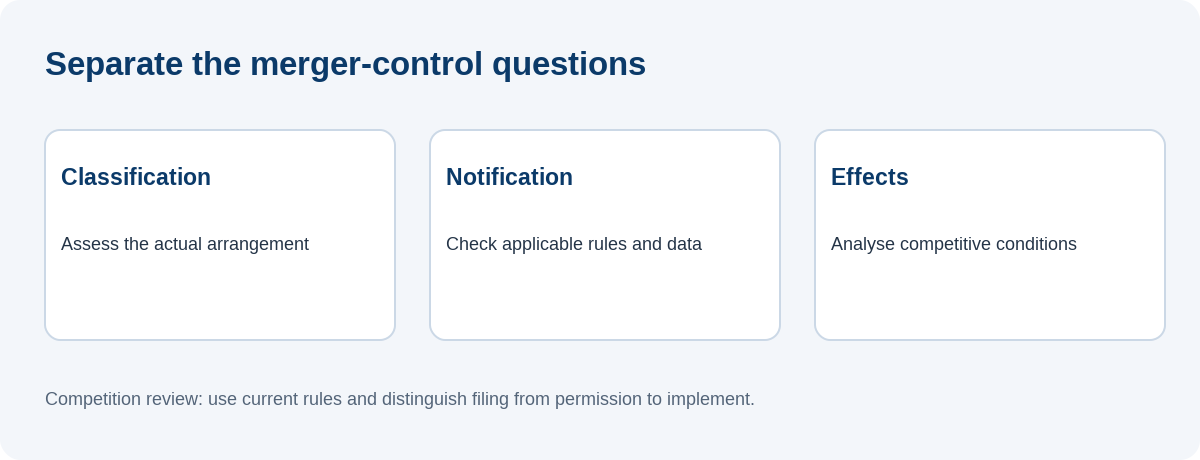
The notification assessment examines the applicable thresholds and rules. The substantive review considers the transaction's competitive effects. Keep these separate in the decision paper: a threshold calculation is not a prediction of the review outcome. Likewise, a commercial view that the deal is beneficial does not remove a filing requirement where it applies.
Article 30 of the Competition Law 2018 addresses economic concentrations causing or potentially causing significant restrictive effects on competition in Vietnam. It does not reproduce the old automatic prohibition based simply on combined market share exceeding 50%. The original article's explanation should therefore not be used as a current decision rule.
An assessment of competition law in M&A needs a dated record of the rules and figures used. Relevant criteria include assets, revenue or purchases, transaction value and combined market share, subject to the applicable provisions. Do not test only the purchase price and assume that a smaller amount resolves all notification questions.
From 1 July 2026, Resolution 66.18/2026/NQ-CP changed three general thresholds for transactions involving enterprises other than credit institutions, insurance businesses and securities companies. The relevant Vietnam asset and revenue or purchase thresholds increased to VND 6,000 billion, and the transaction-value threshold increased to VND 2,000 billion. These changes do not justify replacing every sector-specific or cross-border rule with one universal calculation.
Identify the entities or relevant affiliated groups, financial period and territorial figures required by the rules. Reconcile the information with reliable records and explain assumptions. A target-only number taken from a presentation may not provide the complete basis for assessing a transaction involving larger groups.
Special categories and transactions implemented outside Vietnam need their own examination. The fact that signing or completion takes place overseas is not, by itself, a sufficient reason to omit the Vietnam analysis. Record which rule applies to the actual circumstances rather than infer the answer from the location of the agreement.
Market share is meaningful only in relation to an identified market and a supportable calculation. Explain the products or services, customers, alternatives and geographic circumstances relevant to the proposed analysis. A broad industry label may conceal important differences between the parties' actual activities.
For example, two businesses may use the same general sector description while supplying different customer groups or operating at different levels of the supply chain. Conversely, different brand names do not prove that the businesses do not compete. Prepare a clear factual account and identify which information is verified and which estimates require further work.
Use consistent periods, measures and sources when presenting estimates. Where reliable market-wide data is unavailable, explain the limitation and the method proposed for addressing it. The aim is not to select the market description that produces the preferred number, but to provide a defensible basis for review.
For example, a target's sales report may combine several product lines while an industry estimate measures only one of them. Comparing the totals without adjustment can produce a misleading percentage. Identify the relevant categories, document any allocation and ask the business team to confirm what the records represent. Keep the source figures alongside the calculation so the assessment can be checked when the structure or available information changes.
Competition law in M&A requires attention to how the transaction may change competitive conditions. The relationship may involve direct competitors, businesses at different stages of supply or activities that complement one another. A review should explain the relevant connection rather than reduce every issue to horizontal overlap.
Analyse claims about efficiencies and benefits using evidence. If the deal is said to improve distribution, reduce costs or support innovation, identify the mechanism and dependencies. A list of expected advantages is not an automatic exemption from the current merger-control framework. The legal assessment should use the applicable process and criteria.
Possible outcomes can include permission to proceed, permission subject to conditions or prohibition under the governing framework. The parties should not describe conditional approval as an unrestricted clearance. If conditions are relevant, their operational and financial consequences need to be understood before the business commits to implementing the transaction.
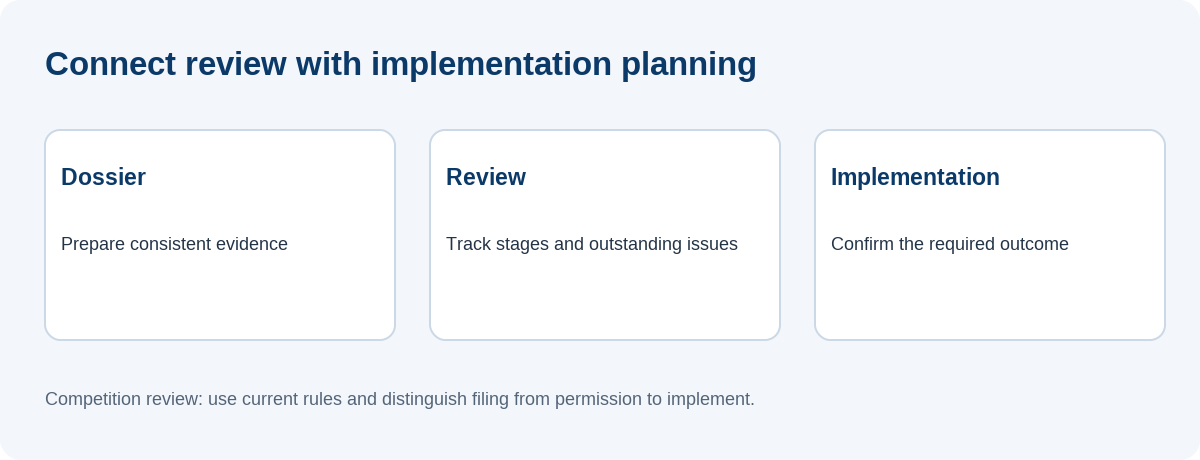
A common planning error is to treat the review period as starting when the parties first collect documents. Distinguish preparation, submission, completeness review and the applicable assessment stages. Requests for clarification or additional information can affect the practical timetable, so the completion plan should reflect dependencies rather than a single optimistic date.
The National Competition Commission's published process describes a 30-day preliminary assessment following receipt of a complete and valid dossier. A case requiring official assessment follows a different stage, generally up to 90 days with a possible extension of up to 60 days. These stages should not be converted into a promise that every transaction will be cleared within the initial period.
Assign responsibility for collecting group data, market information and transaction documents. Agree how questions will be escalated and who confirms the accuracy of factual submissions. A filing team cannot resolve inconsistent figures merely by rewriting the narrative; the relevant business and finance teams need to explain the underlying records.
The transaction documents should address the decisions and actions required for the particular deal. Discuss filing responsibility, cooperation, relevant conditions and the effect of delay or an unexpected outcome. A broad statement that the parties will comply with law may leave important practical questions unanswered.
Consider how a potential condition or remedy would affect the investment case. Identify who decides whether a proposed measure is acceptable and how the parties will assess its consequences. Do not assume that every condition can be implemented without changing the assets, operations or benefits that justified the acquisition.
A legal due diligence review connects this work with the wider transaction structure, authority and material arrangements. Keep the competition assessment visible as a separate workstream so the deal team knows what has been concluded, what is pending and what evidence is still needed.
During a pending transaction, the parties may need to exchange information without acting as though integration has already occurred. Identify what is necessary for diligence and planning, who may receive sensitive material and how access is controlled. Competing businesses should assess information-sharing arrangements with appropriate advice rather than circulate detailed commercial information by default.
Clarify which preparatory activities are permitted and which actions require further assessment before implementation. Signing an agreement does not establish that all operational steps can immediately proceed. Give managers practical instructions about escalation so that integration planning does not create commitments inconsistent with the required process.
After the relevant outcome, retain the decision and evidence supporting implementation. If conditions or continuing commitments apply, allocate responsibility for them and establish how performance will be monitored. The competition workstream is not necessarily finished when the deal team receives an initial message about approval.
For a focused review with Jurion & Partners, prepare the proposed structure, group information, main activities, relevant financial figures and intended timetable. Flag gaps in market data or connected transaction steps. That allows the assessment to begin with the actual facts rather than an unsupported statement that no filing is expected.
>>> Read more: Resolving disputes between shareholders or members of the company
Assessing competition law in M&A means separating classification, notification and competitive effects, then connecting the result with the transaction plan. Use current rules, support the calculations and keep implementation dependent on the required steps. That approach gives decision-makers a clearer account of both the obligations and the uncertainties.






Subscribe today to get more breaking news from Jurion Partners - Solicitors & Litigators

108 Tran Dinh Xu St., Cau Ong Lanh Ward, Ho Chi Minh City, Vietnam
(+8428) 66.701.709 - (+84) 903.419.479
contact@jurionpartners.com
Follow us
Accept payment





 English
 Tiếng Việt