Explore the Legal Counsel role at Jurion & Partners. Contact us to confirm current openings and application requirements.
A legal counsel role calls for more than the ability to identify a rule or produce a technically accurate answer. The work involves understanding a client's objective, establishing the relevant facts and turning analysis into advice that can be used responsibly. If you are considering this position, your application should show how you define a question, work with incomplete information and explain the implications of different choices. The purpose of this article is to help you prepare that evidence and identify the points that deserve discussion before either side makes a commitment.
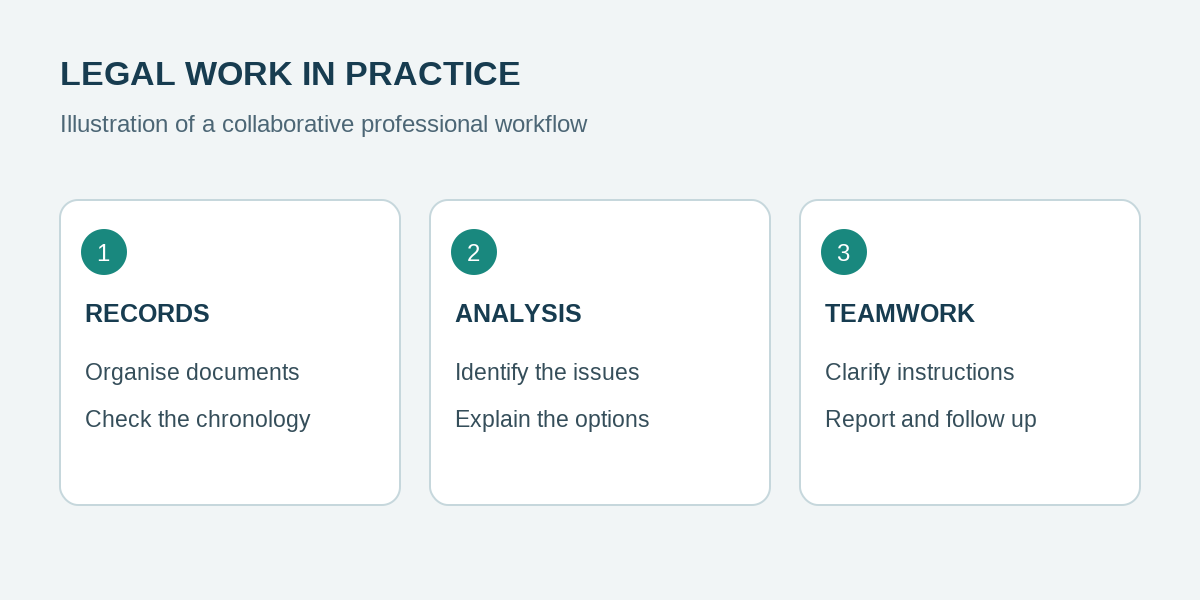
This career information relates to Jurion & Partners. Applicants should confirm whether the position is currently accepting enquiries before submitting detailed materials. The article does not announce a confirmed recruitment round or establish compensation, working hours, benefits, location or an offer of employment. Those matters depend on the actual opportunity and must be discussed separately. The guidance below describes ways to present relevant experience; it should not be read as an additional list of mandatory qualifications.
An advisory assignment often begins with a request that needs clarification. A client might ask for a contract review without explaining the commercial arrangement, the stage of negotiations or the decisions that remain open. Useful work starts by identifying who will use the advice, what outcome is being considered and which documents establish the background. An applicant can demonstrate this skill by explaining how an initially broad request became a defined assignment, including the questions asked before research or drafting began.
Legal counsel should be able to distinguish the analysis requested from work that has not yet been commissioned. In an application, describe your actual responsibility: whether you gathered information, researched an issue, prepared a draft, reviewed another person's work or managed the assignment. If you worked under supervision, say so. Clear attribution allows your experience to be assessed fairly and shows that you understand how responsibility is distributed within a professional team. It is more informative than describing every project as if you had personally directed it.
Research is valuable when its connection to the question is visible. A collection of extracts does not by itself explain whether a source applies to the facts, what assumptions have been made or which points remain unresolved. Prepare an example showing how you framed an issue, selected sources, checked their relevance and identified information that might change the answer. You can describe your method without disclosing a client's identity or reproducing a confidential document. A carefully constructed hypothetical may be appropriate where an original work product cannot be shared.
For legal counsel, acknowledging uncertainty is part of a disciplined approach. An initial view may depend on a document that has not been reviewed, a fact supplied by another party or an interpretation requiring further examination. Your example should explain how you recorded those limits and communicated the need for clarification. Avoid presenting a conditional assessment as a guaranteed answer. An interviewer may learn more from the way you handled an information gap than from a long list of topics you have encountered.
A document's structure should reflect its purpose. A decision-maker may need a concise explanation of the issue and the available choices, while an implementation team may need a clearer account of actions, dependencies and points to verify. When discussing your writing experience, explain how you determined the appropriate level of detail and how you made the principal conclusion easy to find. If a draft was revised after feedback, describe what changed and why. The ability to improve a document is relevant evidence of professional judgment.
A suitable writing sample should demonstrate organisation, accurate attribution and careful use of language. It need not be long, and it should never be shared merely because you still possess a copy. Check whether you have permission to use the material and remove identifying or sensitive information where appropriate. If you create a sample for the application, identify it as a sample. The reader should understand which material reflects actual work, which parts were collaborative and which example was prepared solely to illustrate your approach.
Contract work is not limited to finding wording that could be improved. It requires an understanding of the transaction, the responsibilities each party is expected to perform and the practical consequences of leaving a provision unclear. Applicants can discuss how they connected related clauses, organised comments and distinguished points requiring a business decision from points requiring further legal analysis. The aim is to show a considered review process rather than to suggest that every negotiation has a single correct outcome.
Someone applying as legal counsel can also explain how advice was communicated during a negotiation. For example, how were alternative formulations presented, how were unresolved points recorded, and how was the final version checked against the instructions? Keep the example within the limits of what you can properly disclose. There is no need to identify the parties or reveal transaction values. A description of the reasoning and document-control process can provide meaningful evidence without exposing the underlying commercial information.
Assignments may develop as new documents arrive or a client's priorities change. Explain how you recognise an additional request, assess its effect on the existing work and seek clarification before extending the scope. A useful example might involve separating an urgent question from a broader review or recording a dependency that prevented completion. The important point is not that every assignment followed a perfect plan, but that changes were identified and handled openly rather than allowed to create unspoken expectations.
Collaboration also depends on clear handovers. Research notes, draft documents and review comments should enable another team member to understand what has been done and what still needs attention. Describe how you keep the source material accessible, identify the current version and record substantive comments. Naming a software tool is less useful than explaining the working habit it supports. You may also be asked how you respond when a reviewer disagrees with your analysis, so prepare an example of reconsidering a point on its merits.
Your CV should make your professional background understandable without requiring the reader to infer your level of responsibility. Use concise descriptions of the assignments you handled, the work you personally completed and the skills that work required. State language ability and professional status accurately. Do not assume that an observation in this article establishes a formal recruitment criterion. If the role requires a particular qualification or level of experience, that should be confirmed through the actual recruitment information.
Legal counsel candidates can make their experience more persuasive by choosing a few examples they understand thoroughly. Be ready to explain the initial question, the information available, your contribution and the limits of the result. General statements about being commercially minded or detail-oriented are difficult to assess unless they are supported by an account of how you worked. A balanced example can include an error you corrected or an approach you would now improve.
A recruitment discussion should also help you evaluate the opportunity. Ask how assignments are defined, what kinds of work are expected and how review is organised. These questions are particularly useful where a role description is broad. You can also ask how priorities are managed when several requests arrive together and how substantive changes to an assignment are agreed. The answers should be considered alongside your own professional aims, rather than assuming that a familiar job title means the work will match a previous position.
Think in advance about the information you need to make a decision. You may want to understand the expected balance between research, drafting, client communication and coordination. If a responsibility is outside your previous experience, explain that honestly and ask what support or preparation would be relevant. Such questions do not establish that any particular training arrangement exists; they identify points for clarification. Both sides benefit when the discussion distinguishes the responsibilities already understood from the conditions that still need to be agreed.
Use the contact page to ask whether applications are being received and which submission process is appropriate. Avoid sending original records, client files or unnecessary personal information before the requested materials and arrangements have been confirmed. Sending an enquiry or a CV does not by itself establish an interview, an engagement or an offer. Any further assessment should be based on the actual position and the information the parties agree to exchange.
For context on the legal work discussed here, see the overview of contract drafting and review. This helps explain a practice area; the actual duties of any role must be confirmed during recruitment.
When exploring a legal counsel position, aim for an application that is specific, accurate and easy to discuss. Show how you understand a client's question, analyse the available material and communicate a usable answer within a clear scope. Equally, identify what you need to know about the role before deciding whether it fits your professional direction. That preparation creates a sound basis for a focused conversation about responsibilities, expectations and the practical terms of working together.





Subscribe today to get more breaking news from Jurion Partners - Solicitors & Litigators

108 Tran Dinh Xu St., Cau Ong Lanh Ward, Ho Chi Minh City, Vietnam
(+8428) 66.701.709 - (+84) 903.419.479
contact@jurionpartners.com
Follow us
Accept payment





 English
 Tiếng Việt