Prepare appropriate interpretation and document translations for civil proceedings in Vietnam, including disability-related communication needs and court acceptance.
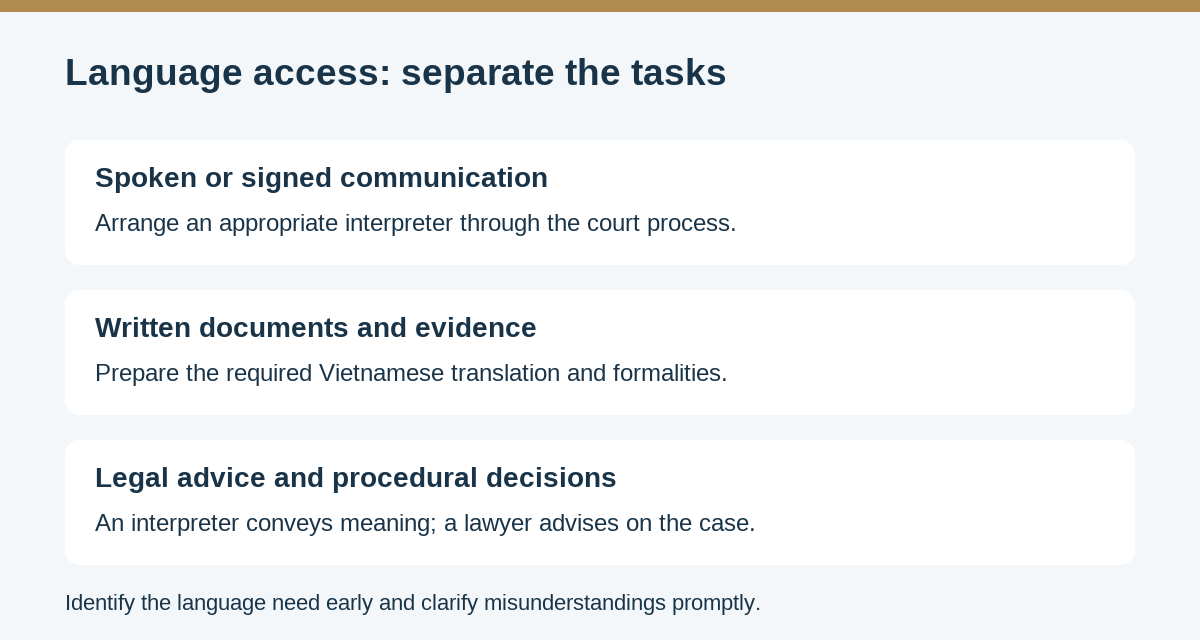
Language rights in Vietnamese civil proceedings allow participants to communicate through appropriate interpretation even though Vietnamese is the procedural language. The practical arrangements matter: an interpreter must be suitable for the task and accepted or requested by the court under the applicable rules. Foreign-language documents also need separate attention, because spoken interpretation at a hearing does not automatically satisfy the requirements for written evidence.
Article 20 of the Civil Procedure Code identifies Vietnamese as the language and writing used in civil proceedings while recognizing participants' right to use their own ethnic language and writing with an interpreter. The question is therefore not limited to whether a person holds a foreign passport. A participant's actual communication needs should be identified early.
The provision also addresses participants with hearing, speech or visual disabilities using their particular language, signs or writing, with a person able to interpret them. These arrangements should not be reduced to a choice between Vietnamese and English. Explain the particular language or communication method required so that the court can assess suitable assistance.
Being able to manage everyday conversation is different from understanding questions about a claim, an agreement or the effect of a court record. A participant should accurately describe any difficulty instead of pretending to understand out of embarrassment. Equally, language arrangements should reflect genuine needs rather than be used to obstruct the proceedings.
Article 81 addresses a person capable of interpreting between another language and Vietnamese where a participant cannot use Vietnamese. One party may select an interpreter, or the parties may agree on one, subject to the court's acceptance. The court may also request an interpreter. A private booking alone should not be treated as confirmation that the proposed person has been accepted for the proceeding.
Notify the court of the need as early as reasonably possible. Identify the case reference, participant, required language and relevant communication difficulties. If proposing a particular person, provide the information needed to assess their suitability and clarify their availability for the relevant event. Avoid assuming that anyone who speaks two languages can interpret specialized evidence accurately.
For disability-related communication, Article 81 includes specific recognition of people who know the relevant writing, language or signs. It also addresses the special situation where only a representative or relative knows that person's communication method and may be accepted by the court. This should not be expanded into a general rule that any relative is automatically entitled to interpret.
The interpreter conveys what is said accurately; the lawyer advises and protects legitimate interests within the permitted role. A bilingual lawyer's presence should not automatically be treated as a substitute for an accepted interpreter. Article 82 includes restrictions where the proposed interpreter has participated in another specified role in the same case, including protecting a party's legitimate rights and interests.
Similarly, a friend should not answer questions on a participant's behalf while describing the answer as interpretation. The participant supplies their own evidence or explanation, and the interpreter conveys it. If a question or term is unclear, clarification should be sought openly rather than silently replacing it with what someone thinks the participant ought to say.
This distinction protects the accuracy of the record. It also helps avoid confusion when the person who arranged assistance has a personal interest in the outcome. Disclose relevant relationships and previous involvement so that suitability can be examined before the hearing rather than becoming a surprise during it.
Article 82 requires truthful, objective and accurate interpretation, attendance under the court's summons and a commitment before the court concerning performance of the role. It permits the interpreter to request further explanation of material needing interpretation. Seeking clarification of an unfamiliar term can therefore be part of careful performance rather than a sign that accuracy is unimportant.
The article also prohibits contacts affecting the truthfulness, objectivity or accuracy of interpretation. This does not justify a vague suggestion that every practical conversation is forbidden. The concern is interference with faithful performance, such as coaching an answer or agreeing to omit material information from what is conveyed.
Participants can help by speaking in manageable sections and identifying names, dates or document references clearly. If numbers matter, ask that they be checked rather than relying on a hurried summary. Practical preparation should support faithful interpretation, not turn into rehearsal of a misleading account.
Language rights in Vietnamese civil proceedings do not mean that foreign-language evidence can simply be submitted without the required Vietnamese translation. Article 96(3) requires documents and evidence in a minority language or foreign language to be accompanied by a Vietnamese translation lawfully notarized or authenticated. Spoken explanation of a document at a meeting is a different task.
Keep the source document and translation together, with matching page references. Check names, dates, amounts and important qualifications, especially where one word changes an obligation or deadline. A document register helps identify which version was translated and whether attachments were omitted. Do not describe a partial translation as the entire agreement.
Translation requirements should also be distinguished from any authentication or legalization questions concerning foreign-issued documents. One process does not automatically resolve the other. The particular document, issuing authority and any applicable exemption require assessment before deciding what formalities are necessary.
In a fictional contract dispute, a participant provides an English agreement and needs assistance answering questions in court. Preparing a compliant Vietnamese translation of the agreement does not automatically arrange oral interpretation for the participant. Conversely, having an interpreter available does not establish that the written evidence has been translated in the required form.
Article 82 identifies circumstances requiring refusal or replacement, including specified impartiality concerns and prior participation in incompatible procedural roles. A disagreement with an answer is not by itself proof of bias, but a relevant relationship, prior role or specific example of inaccurate interpretation should be described clearly.
Under Article 83, a refusal or request for replacement before the hearing or meeting must be made in writing with reasons. At the hearing or meeting, it must be recorded in the minutes. Preserve the relevant facts and explain the concern through the proper procedure rather than privately pressuring the interpreter to alter an answer.
Article 84 distinguishes the decision-maker before the event from the judge or relevant adjudicating body during it. Where replacement is required, the provision addresses postponement and arranging another interpreter. Raising a genuine concern early can help the court examine it before the scheduled event, but no participant should be promised an automatic replacement merely because they prefer someone else.
Article 168 addresses interpreter costs separately from lawyer fees. It provides that the person requesting the service bears the relevant costs unless the parties agree otherwise, while the court pays where it requests the interpreter. Identify how the interpreter is being engaged and what arrangement applies rather than telling every participant that the other party or the court must pay.
Clarify the scope of an estimate: attendance, preparation, travel or additional sessions may need discussion. Written evidence translation may be a separate service. Keep the arrangement transparent and avoid assuming that payment gives anyone permission to influence interpretation or guarantees the proposed interpreter's acceptance by the court.
Before a scheduled event, identify which language assistance has been requested and what remains to be confirmed. Bring the relevant notices and organized document copies. Tell the adviser promptly if the proposed interpreter becomes unavailable or if the participant's communication needs were incorrectly described.
Do not sign merely because someone says the document is routine. If the participant cannot understand the recorded statement or proposed agreement, raise that issue before confirming it. The appropriate response is to seek an accurate explanation through the procedural arrangements, rather than rely on a private assurance that the wording probably does not matter.
A relative's language ability may be useful privately, but court participation requires examination of the legal conditions and acceptance process. Relevant interests or incompatible roles can matter. The disability-related provision has a particular scope and should not be treated as unlimited permission for relatives in every proceeding.
The interpreter's responsibility is accuracy, not persuasion. If the participant's answer needs clarification, the question and explanation should be handled transparently. Substituting a stronger answer can distort evidence and defeat the purpose of the assistance. Legal advice and interpretation should each be supplied within their proper role.
The guide to drafting a lawsuit petition in Vietnam helps organize the parties, requested relief and evidence. Identify language and translation needs alongside that preparation so they can be addressed before a filing or hearing becomes urgent.
>>> Read more: Competence of Vietnam courts over civil cases with foreign elements
>>> Read more: Legal consequences of withdrawal of lawsuit petitions in civil cases
Jurion & Partners can assess the proceeding, proposed assistance and document requirements so the participant understands the arrangements being requested. Effective use of language rights in Vietnamese civil proceedings combines early notification, an appropriate interpreter, properly prepared translations and prompt clarification of any misunderstanding affecting participation.





Subscribe today to get more breaking news from Jurion Partners - Solicitors & Litigators

108 Tran Dinh Xu St., Cau Ong Lanh Ward, Ho Chi Minh City, Vietnam
(+8428) 66.701.709 - (+84) 903.419.479
contact@jurionpartners.com
Follow us
Accept payment





 English
 Tiếng Việt