When companies undergo mergers and acquisitions (M&A), most attention is placed on financial results or market expansion.
The human resource advantages and disadvantages of mergers and acquisitions depend on what happens to the people who operate the businesses. A buyer may obtain access to experienced teams and new knowledge, yet lose that value if roles become unclear, trusted managers leave or essential work is interrupted. Reviewing employees only as a cost in the valuation misses the capabilities and relationships that may justify the acquisition.
This guide examines practical workforce opportunities and risks in a transaction involving a Vietnamese business. It connects personnel review with retention, communication and integration planning, while distinguishing commercial choices from employment obligations. The objective is to preserve useful capabilities and manage necessary change through a plan that employees and managers can understand.
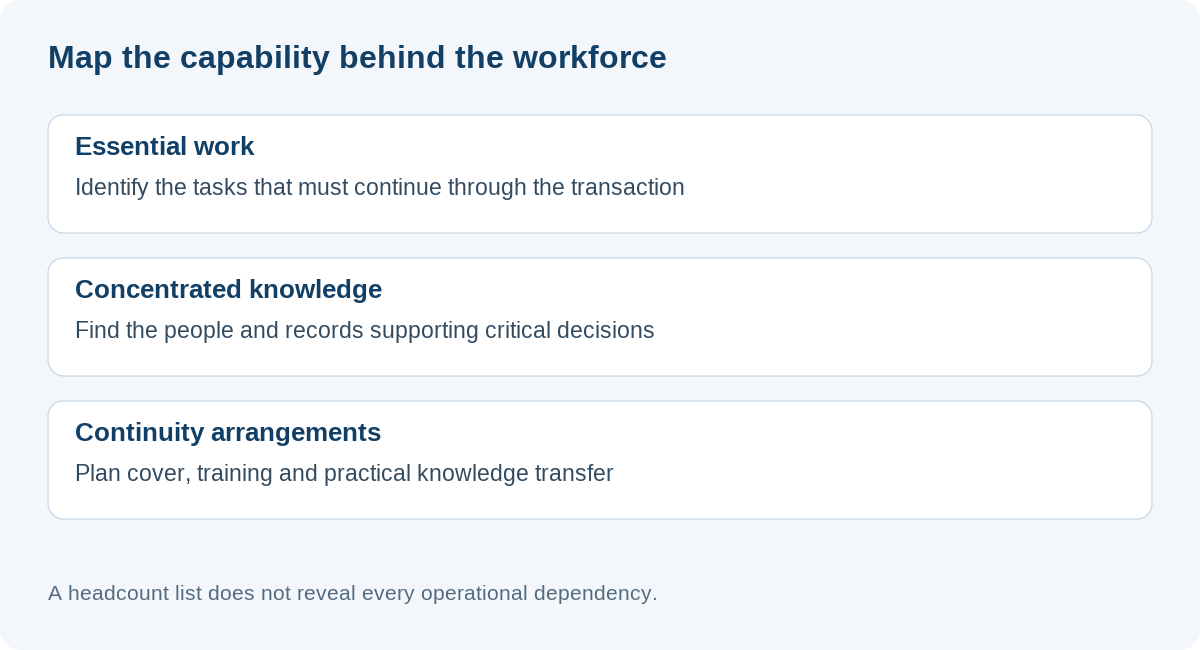
Begin with the work that must continue, rather than a proposed organisation chart. Identify the teams responsible for customer service, production, technical support, payroll and essential approvals. Then establish where knowledge, authority and relationships are concentrated. A small team may carry a business-critical responsibility that its headcount does not reveal.
Compare formal job descriptions with actual responsibilities. A manager might also maintain a supplier relationship or resolve technical problems without those duties appearing in the personnel file. Understanding that reality helps the buyer assess continuity and avoid removing a role before its less visible functions have been reassigned.
A change in shareholders should not simply be treated as a new employment contract or an automatic ground for dismissal. Identify whether the employing entity remains the same and what operational changes are actually proposed. A statutory merger, asset transfer and share purchase can raise different implementation questions.
Under Article 43 of Vietnam's Labour Code, as consolidated in 18/VBHN-VPQH of 2026, specified reorganisations and transfers affecting many employees' jobs require a labour utilisation plan. Article 44 addresses its contents, consultation and communication. Assess those requirements against the actual transaction and workforce impact before fixing an implementation timetable.
An acquired team may understand customers, equipment or delivery methods that the buyer has not previously served. That experience can shorten a learning process if the team has the resources and authority to contribute. Ownership alone does not transfer every employee's practical knowledge to the rest of the group.
Identify how knowledge will be shared. Joint problem-solving, documented handovers and paired assignments may be more useful than a large introductory presentation. Give the employees responsible for teaching enough time to do so without neglecting their existing work.
A combined group may offer employees access to different products, training or specialist roles. These opportunities become credible when managers can explain the skills required, selection process and support available. A general promise of career growth is unlikely to resolve uncertainty about an employee's immediate responsibilities.
Training should follow an identified need. Employees moving to a new system may require practical exercises and a support contact, while a technical specialist taking on management work may need guidance on delegation and performance discussions. Budget for the time spent learning as well as the training fee.
Combining compatible teams may reduce dependence on one person and provide cover during absence or peak demand. Shared payroll, recruitment or learning resources can also improve consistency where they are properly designed. Establish service responsibilities so that centralisation does not leave local teams unsure who can solve an urgent problem.
Benefits should be assessed rather than assumed. A larger organisation may have more resources, but employees do not automatically receive improved compensation or benefits merely because an acquisition occurs. Describe confirmed changes accurately and distinguish them from proposals still being evaluated.
In assessing the human resource advantages and disadvantages of mergers and acquisitions, look beyond broad descriptions of cultural conflict. Employees need to know how decisions are made, what standards apply and where to obtain answers. Persistent uncertainty in those areas can interrupt ordinary work even before any formal restructuring begins.
Two managers may assume responsibility for the same function, or each may expect the other to make a decision. Employees can receive conflicting instructions about pricing, expenditure or customer commitments. Establish interim authority arrangements while the longer-term organisation is being designed.
Use concrete scenarios to test the arrangements. If a customer needs urgent technical support, who allocates staff and approves the cost? If a supplier demands a payment decision, who has access to the records? A workable answer is more valuable than an integration chart that does not reflect everyday decisions.
Employees may reconsider their future when they do not understand the new owner's plans. Retention discussions should explore the reasons a person might leave, including role uncertainty, workload or professional development. A payment can be useful but may not resolve those underlying concerns.
Plan for continuity without assuming that every identified employee will stay. Document essential procedures, distribute knowledge and identify cover for critical tasks. These steps support the business even where the employee remains, and reduce pressure on individuals who have become the sole source of an important skill.
Teams may have different bonus arrangements, appraisal methods or working practices. Before proposing alignment, establish what has been agreed, what has been paid in practice and what employees have been told. Comparing job titles alone can conceal differences in responsibility, experience or location.
Explain the purpose and process of any review without promising outcomes that have not been authorised. Managers should have consistent guidance on what is confirmed, what remains under assessment and when further information is expected. Informal assurances can create confusion that later communications struggle to correct.
The human resource advantages and disadvantages of mergers and acquisitions should inform the documents requested during review. Examine the records needed to understand employment arrangements, compensation commitments and operational dependencies. Avoid collecting sensitive personal details simply because a data room can accommodate them; determine what the review needs and manage access appropriately.
For the broader framework, consult the guide to employment contracts in Vietnam. The transaction team should then convert the relevant findings into assigned actions, budget assumptions and conditions that can be checked before implementation.
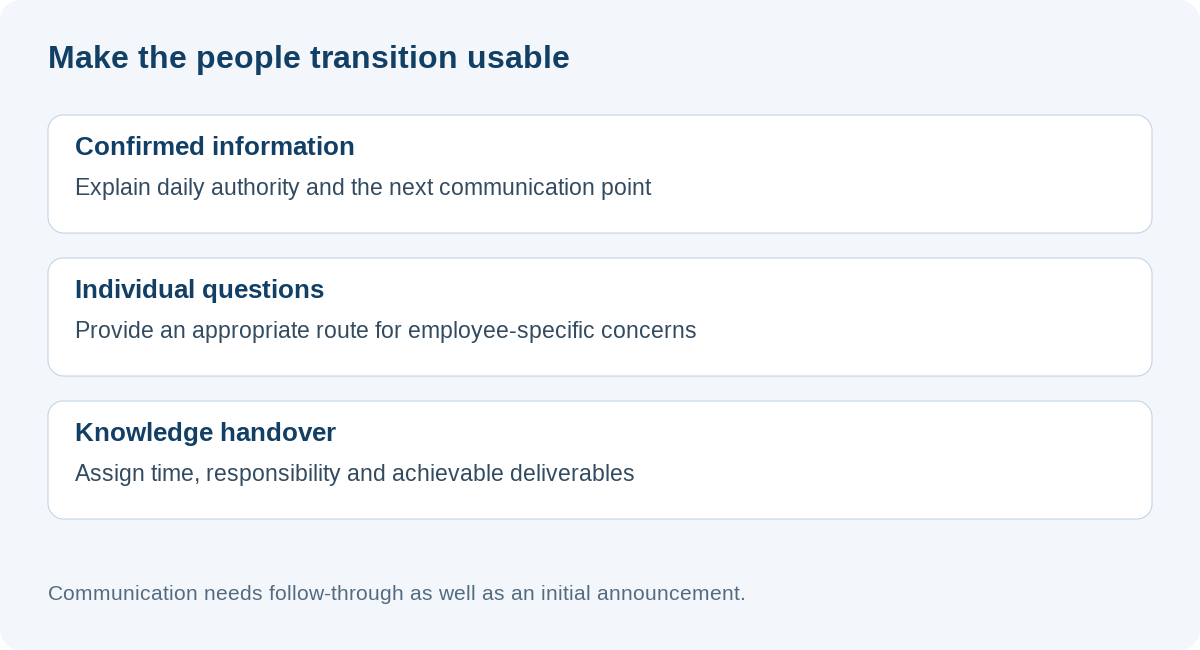
Identify the role the business needs, the expected period of contribution and the support required. If an incentive is proposed, describe its conditions, measurement and payment process clearly. Consider whether the arrangement supports a real transition objective or simply postpones a difficult staffing decision.
A technical lead may need a defined mandate to train successors and complete documentation. A customer manager may need time to introduce colleagues and explain service arrangements. The plan should make those deliverables achievable within the employee's workload rather than adding them to an unchanged list of duties.
Before an announcement, prepare answers to the questions employees are likely to ask: who remains responsible for payroll, who manages daily work and when further decisions will be communicated. Share confirmed information at the appropriate stage and identify a route for questions that require individual discussion.
Consistency does not require pretending that every decision has already been made. An honest explanation of the review process and its next update is more useful than an unsupported promise that nothing will change. Train managers to distinguish agreed facts from their own expectations.
Operational overlap may prompt a review of roles, but projected savings do not replace the applicable employment process. Establish the business proposal, affected work and alternatives before announcing individual outcomes. Coordinate the legal review with HR and the managers responsible for maintaining service.
Where a labour utilisation plan is required, Article 44 covers categories of continuing, retrained and departing employees, relevant responsibilities and implementation funding. The plan is subject to consultation with the workplace employee representative organisation where one exists, and public communication to employees within 15 days after adoption. Avoid substituting a generic integration presentation for that process.
Use realistic cost estimates and verify each employee's circumstances before calculating payments. Different forms of departure should not be treated as having an identical payment basis. Keep decision records and supporting calculations so that implementation can be reviewed and employee questions can be answered accurately.
Suppose a buyer acquires a maintenance business and initially plans to combine its dispatch function with an existing central team. The workforce review shows that the target's dispatcher also holds detailed knowledge of customer access arrangements and identifies which technicians can service particular equipment.
Removing the role immediately could disrupt service even if the central team has spare administrative capacity. The buyer can instead map that knowledge, arrange accompanied scheduling work and test the new process with selected customers. It should separately examine the employment implications of any proposed role change.
This example shows why a headcount reduction is not the same as an operational improvement. The transition plan needs evidence that the receiving team can perform the work, adequate time for handover and a clear decision about the employee's future role. The cost model should reflect that sequence.
A review of the human resource advantages and disadvantages of mergers and acquisitions should continue after completion. Monitor continuity in essential roles, completion of training and handovers, unresolved employee questions and service problems associated with the transition. Use these measures to adjust the plan rather than relying only on whether the new organisation chart has been published.
Jurion & Partners can assist with reviewing employment-related transaction findings and the legal process for proposed workforce changes. A focused brief should identify the employing entities, intended operational changes and the personnel issues that could affect continuity.
>>> Read more: Foreigners Divorce in Vietnam
>>> Read more: Custody of children in divorce disputes
The human resource advantages and disadvantages of mergers and acquisitions become manageable when the buyer understands the work, people and obligations behind the transaction. Preserve essential knowledge, give employees reliable information and assess proposed changes through the appropriate process. That approach provides a stronger basis for integration than treating the workforce solely as a source of savings.






Subscribe today to get more breaking news from Jurion Partners - Solicitors & Litigators

108 Tran Dinh Xu St., Cau Ong Lanh Ward, Ho Chi Minh City, Vietnam
(+8428) 66.701.709 - (+84) 903.419.479
contact@jurionpartners.com
Follow us
Accept payment





 English
 Tiếng Việt