Understand when an IRC application is easier to manage and which unresolved legal, evidence and business questions should be addressed before filing.
IRC application readiness is a useful way to assess whether obtaining an Investment Registration Certificate in Vietnam is likely to be manageable. A defined project, suitable premises, credible funding evidence and an available decision-maker can reduce avoidable questions. They cannot guarantee approval. The practical question is which facts are settled, which require legal assessment and which commercial decisions must be made before the application accurately describes the proposed investment.
A ready project can be explained consistently and assessed under the correct legal route. The investor knows what it intends to do, where, through which entity and with what resources. Supporting records match that explanation. A polished proposal does not establish readiness if the activities are still changing or the proposed premises have not been checked.
The current framework includes the Law on Investment 143/2025/QH15 and Decree 96/2026/ND-CP. These distinguish projects requiring an IRC, project approval procedures and other investment forms. The initial review should establish whether the proposed transaction belongs in an IRC application at all. Preparing a new-project dossier for a transaction requiring a different analysis creates work without answering the legal question.
Readiness is different from certainty. A well-prepared project may still require substantive assessment of market access, planning, technology or other conditions. Conversely, a conventional business can become administratively difficult because its records conflict. Separate complexity inherent in the project from problems the applicant can correct before filing.
Describe the proposed operation in commercial terms before translating it into legal classifications. Identify its services or products, customers, delivery method and the work performed in Vietnam. “Business support” may be too broad if the proposed operation also includes distribution, regulated advice or another distinct activity. Explain the boundaries of the immediate business and identify what is genuinely planned for later.
Consider an overseas group planning an office that provides research to affiliates. During preparation, management proposes adding sales to local customers and importing equipment for resale. That is more than an editorial change. The additional activities require assessment of the relevant conditions and may affect the project description, premises, budget and subsequent operating requirements.
Improving IRC application readiness means making those decisions early. If an activity is deferred, the record should describe that status accurately. It should not be omitted while the business intends to carry it on immediately. Advisers need the actual plan to assess the requirements and avoid an application that understates the proposed operation.
Identify the legal entity or individual making the investment. Group brands, holding companies and operating affiliates can appear together in commercial presentations but are not interchangeable applicants. Confirm the ownership structure and authority to approve the investment. A late change of investor may affect legal-status records, financial evidence, signatures and several other parts of the file.
Check market access against the actual investor and activities. Foreign ownership alone does not answer every question about permitted participation. Relevant conditions and treaty commitments need assessment where applicable. Do not assume that a wholly foreign-owned structure is always prohibited or always available, or that appointing a nominal local participant cures an unresolved legal issue.
The current framework permits company establishment before completion of the IRC procedure in the circumstances it addresses. Article 72 of Decree 96 attaches a market-access undertaking, a 12-month requirement to complete the project IRC procedure and restrictions on adding other business lines before issuance. The company may implement the project only after completing the required investment registration procedure.
Include those conditions in the readiness discussion. Incorporation may help the team organise certain matters but does not remove the need to assess the project. The IRC-first sequence is also recognised. Select a route because it fits the investment and its dependencies, rather than because an older checklist presents one sequence as mandatory for everyone.
A proposed address is insufficient if the available documents do not establish the right to use the premises or the premises are unsuitable for the intended activity. Review the location records and proposed lease or other arrangement. Check the relationship between the stated project location, the actual unit or area, and the documents supplied by the person offering it.
For example, a commercial team may negotiate one office suite while receiving property records identifying another floor. Resolve that mismatch before repeating it in the proposal and application. Likewise, premises chosen for low rent may introduce planning, building-use or other questions that make them unsuitable. Discovering this after signing an unconditional long-term lease can create a commercial problem as well as an application issue.
The review should reflect the project. Manufacturing raises different site, equipment and environmental questions from an office-based service. A clear documentary position does not automatically satisfy every specialist condition. Identify the particular issue, the evidence required and the person responsible for resolving it. Do not describe a site as approved merely because an agent has recommended it.
IRC application readiness improves when the budget and capacity evidence tell the same story. Set out the resources the project requires and their proposed sources. Distinguish charter capital, total investment capital and other financing. Decree 96 recognises that charter capital need not equal project investment capital; repeating one number throughout the file is not a substitute for a funding assessment.
The dossier rules provide alternatives for financial-capacity evidence, including relevant financial statements, support commitments, guarantees or other material. Select evidence appropriate to the investor and proposal. A large group's public profile does not by itself establish that the particular applicant has access to its funds. Explain who will provide the resources and how that position is supported.
A useful review asks whether funding is approved, what remains conditional and whether the proposed timing supports implementation. If a commitment depends on a later corporate decision, identify that dependency. Do not describe funds as available merely because they are expected. Banking, contribution and borrowing questions may require separate advice before payments are made.
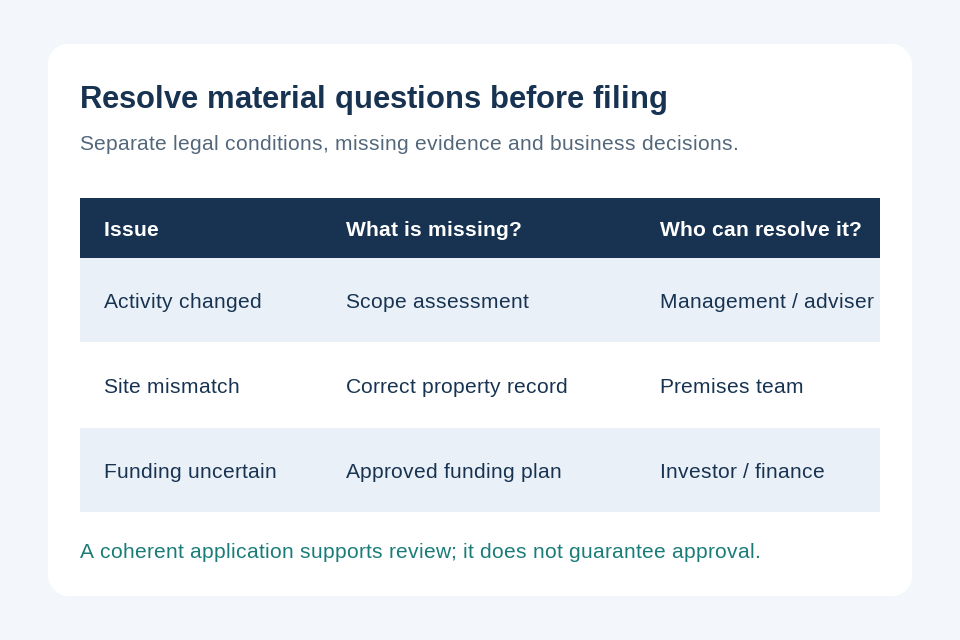
Some apparent document problems are unresolved business choices. Finance may not have approved the budget, operations may be comparing sites and management may not have selected the investing entity. Asking an adviser to complete the proposal cannot replace those decisions. Identify each decision, its owner and the information needed to make it.
Use a short issue register rather than an expanding collection of drafts. For each material question, record the current fact, the gap and the next action. Prioritise matters that change the legal route or several documents at once. That is more useful than repeatedly correcting minor wording while the underlying structure remains unsettled.
Once management resolves an issue, update the affected documents. A new location may change the proposal, lease evidence and authority analysis. A revised budget may affect capacity evidence and the timetable. Identify approved versions and keep paper and electronic records consistent. An application should reflect the investor's instructed plan, not a convenient assumption introduced to fill an empty field.
A review of IRC application readiness should separate preparation, any prior approval or selection process, and the particular IRC consideration period. Article 39 of Decree 96 provides a 10-working-day period from a valid dossier for the ordinary route outside investment policy approval, subject to its conditions. Other defined situations follow different rules. This does not measure the entire market-entry programme.
Under Article 6, the applicant's supplementation or explanation time is excluded from the relevant procedural period. A clear initial file can reduce avoidable amendments but cannot eliminate lawful assessment or guarantee that no explanation will be requested. Allow time to obtain records, internal approvals and signatures, particularly where several jurisdictions or group entities are involved.
Before fixing a launch date, distinguish tasks within the applicant's control from dependencies on other parties. Obtaining a landlord's records, receiving an investor's authorisation and completing a required review are different events. A useful programme identifies the assumptions behind each milestone and is revised when the facts change, rather than retaining a date that has become unattainable.
An IRC records the investment project; it does not certify that every subsequent obligation is complete. Identify sector, premises, tax, employment, environmental and other requirements relevant to the actual operation. Any incentive also needs its own legal basis and conditions. Do not build the budget around an assumed tax holiday simply because the project will hold an IRC.
The broader guide to procedures for foreign investment in Vietnam places the certificate within the investment process. Use that framework to distinguish the registration milestone from the point at which the planned activities may lawfully begin. Explain remaining conditions to the operational team so that it can prepare an achievable launch plan.
A discussion with Jurion & Partners can focus on an activity description, ownership outline, premises record and funding plan. Ask which issues concern legal conditions, which concern missing evidence and which require management decisions. This produces a more actionable preparation plan than a general assurance that the procedure is straightforward.
Good IRC application readiness makes a project easier to explain and its application easier to manage. It comes from resolving material questions, supporting the actual proposal with evidence and keeping the record consistent. Where important facts remain open, resolve them deliberately before filing rather than disguising uncertainty with confident wording or an unsupported promise of approval.





Subscribe today to get more breaking news from Jurion Partners - Solicitors & Litigators

108 Tran Dinh Xu St., Cau Ong Lanh Ward, Ho Chi Minh City, Vietnam
(+8428) 66.701.709 - (+84) 903.419.479
contact@jurionpartners.com
Follow us
Accept payment





 English
 Tiếng Việt