Match applicable IRC project conditions with supporting evidence and distinguish investment registration from company formation and operating requirements.
IRC eligibility requirements in Vietnam concern the investment project and the legal route applicable to it. They should not be reduced to a passport, a proposed company name and a capital figure. An investor needs to establish whether an Investment Registration Certificate is required, identify the relevant project conditions and prepare evidence addressing them. The distinction between a substantive condition and the document proving it is essential: a complete-looking folder cannot make an unsuitable project eligible.
The Law on Investment 143/2025/QH15 distinguishes projects requiring an IRC from projects and investment forms outside that requirement. A new foreign-investor project, a project implemented by an existing economic organisation and an acquisition of shares should not automatically be treated as identical. First identify the investor, the proposed structure and the project to which the assessment relates.
Also determine whether investment policy approval is required. The ordinary IRC procedure for a project outside policy approval is addressed in Article 39 of Decree 96/2026/ND-CP. Other categories follow different routes. A condition discussed for that ordinary procedure should not be described as the complete approval framework for every large or specialised investment.
For the ordinary route, Article 39 addresses a lawful activity, an identifiable project location, planning compatibility, applicable local investment-density or employment conditions, foreign-investor market access and relevant technology conditions. Several elements are expressly conditional. The assessment should identify which apply to the actual proposal rather than invent an additional requirement simply to fill every section of a checklist.
The project must not fall within prohibited investment activities under the applicable law and investment treaties. That question differs from whether an activity is subject to conditions. A conditional activity may be available if its requirements can be met. It should not be described as prohibited merely because it is regulated or associated with a specialised licence.
Describe the actual products, services and delivery model. For example, a project described generally as a technology business may combine software work, equipment sales and other services. Each relevant function needs assessment. A project objective that uses a broad commercial label can obscure an activity that changes the applicable conditions.
Article 8 of the Investment Law provides for foreign-investor market-access conditions, which may concern ownership, investment form, activity scope, capacity, partners or other prescribed matters. Establish the actual investor's position and the conditions applicable to its activities. Full foreign ownership being available does not automatically answer every operating-licence question.
General business conditions and foreign-investor market-access conditions must be distinguished. A requirement may apply to both domestic and foreign businesses; another may arise specifically from the foreign investment position. Record the legal basis and the stage at which each must be satisfied. An IRC is not a universal substitute for all subsequent permissions.
The location element of IRC eligibility requirements calls for more than inserting a street address. Article 39 recognises relevant land-use information available for official database checks, valid copies of land-use documents, a valid location lease arrangement or other material establishing the right to use the proposed site. Select evidence appropriate to the actual arrangement.
Check that the documents identify the same premises as the proposal. A lease for a different unit, an unexplained change in parcel details or records supplied by someone without the relevant authority can create a substantive question. Resolve the mismatch rather than repeating the proposed address in another declaration.
Consider suitability as well as availability. A landlord's willingness to rent does not establish that the location can lawfully accommodate the intended operation. Manufacturing, warehousing and office services can raise different questions. The investor should know what legal use is supported by the records and which further assessment is needed before signing commitments that depend on the location.
Article 39 links the ordinary procedure to the planning requirements referred to in Article 32 of Decree 96. The relevant inquiry depends on the project and location. A business should not assume that a site is suitable because a similar enterprise operates nearby or a property advertisement describes it as available for commercial use.
Identify what the proposal needs from the location, including its scale and activities, and obtain advice on the relevant planning position. If an issue remains unresolved, record the dependency and its effect on the project. A proposal should not present an uncertain site assumption as an established legal fact.
There is no sound basis for saying that all manufacturing projects or all foreign-owned companies must meet one standard minimum investment figure. The applicable analysis may involve sector rules, the particular project and any relevant local conditions. Article 39 refers to locally prescribed investment density per land area and employment numbers where applicable. These should not be turned into a national minimum applying to every proposal.
Separate those conditions from financial capacity. A project may need evidence that its proposed resources are credible even where no universal capital threshold applies. Explain the investment budget, financing sources and implementation timetable. Distinguish charter capital from total project investment; Article 72 of Decree 96 expressly recognises that the amounts need not be equal.
Article 32(1) includes alternatives such as recent financial statements, a parent-company support commitment, a financial institution's commitment, a financial-capacity guarantee or other evidence. The dossier should use appropriate material rather than assume that every investor must submit the same two-year audited record. Article 6 addresses the treatment of financial statements and commitments, subject to other applicable law.
Financial evidence must relate to the actual investor and proposal. A parent company's figures and an applicant subsidiary's resources are different facts. If the plan depends on support, explain and document that position. Do not describe a proposed contribution as completed or treat a group relationship as proof that every entity may use the same funds.
The technology element in Article 39 applies where the project requires the relevant technology consultation under technology-transfer legislation. It is not a blanket instruction that every investor must commission an identical technical report. Establish whether the project's technology triggers that assessment and prepare the information required for the actual process.
Other legal workstreams can also affect the investment plan, including land, construction and environmental matters. Identify them without claiming that the IRC authority decides every issue at once. A required preliminary assessment, a later permit and an operational compliance duty can arise at different stages. The timetable should make those distinctions visible.
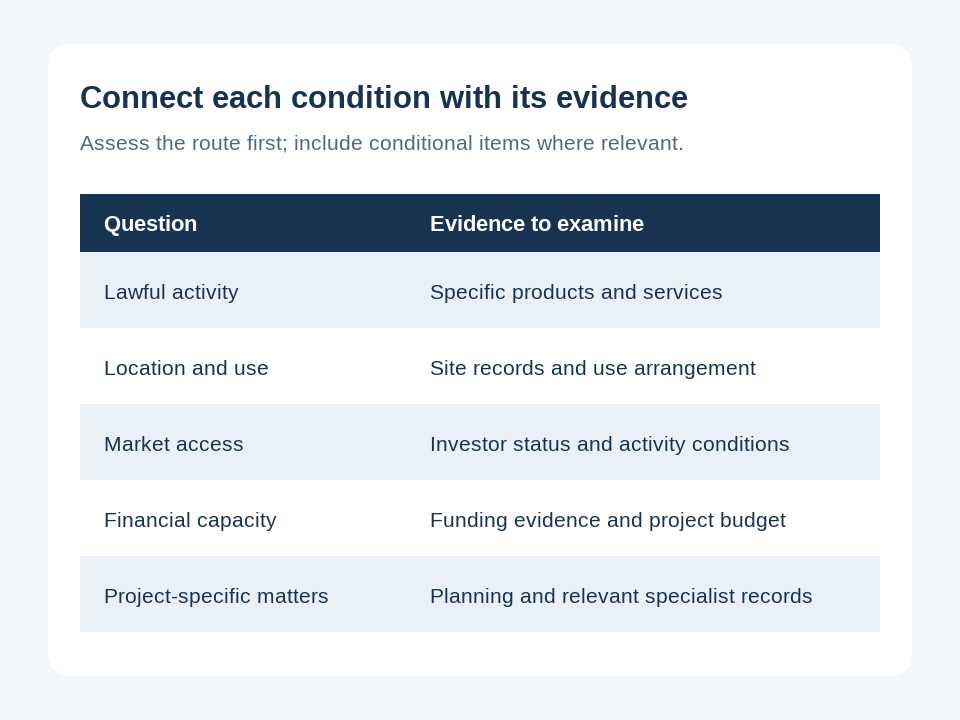
A useful review of IRC eligibility requirements can be organised as a condition-and-evidence matrix. Identify the legal question, the available record, any inconsistency and the next action. For location, that may involve site-use records and the lease. For market access, it may involve the activity description and investor status. For financial capacity, it may involve the relevant support or funding documents.
For example, suppose an investor proposes a small service office but its budget includes major production equipment. The discrepancy could reflect an inaccurate budget or an incomplete activity description. Resolve the underlying facts before deciding which documents to submit. A formally signed proposal remains unreliable if different sections describe different projects.
Use proportionate evidence and the prescribed dossier. Article 6 of Decree 96 provides that the receiving authority must not require documents beyond those prescribed by the law and decree. If a requested item appears unclear, examine the stated basis and the actual project issue. Do not assume that adding unrelated records will improve the application.
A valid dossier and substantive compliance are connected but different. The relevant information must be complete and accurate, and the project must meet the applicable conditions. A receipt confirms submission, not a favourable decision. The investor remains responsible for the legality, truthfulness and accuracy of its application material.
For the ordinary Article 39 route, the consideration period is 10 working days from receipt of a valid dossier, subject to the stated framework. Other defined categories have different provisions. The applicant's supplementation or explanation time is excluded under Article 6. Do not describe this as a guaranteed total project timetable or retain an older general 15–20-day estimate without identifying its legal basis.
Meeting IRC eligibility requirements does not establish a mandatory IRC-first sequence for every company. The current framework recognises a company-first route with specific conditions, including the market-access undertaking and the obligation to complete the project IRC procedure within 12 months. That route does not permit implementation of the project before completing the required investment registration procedure.
After issuance, review the certificate against the approved project and identify remaining obligations. Incorporation, contribution, banking, tax, employment and sector matters need appropriate assessment. Incentives are also conditional on their own legal basis; holding an IRC alone does not automatically grant a tax holiday or land benefit.
The wider guide to procedures for foreign investment in Vietnam helps connect these stages. Use it to organise responsibilities so that the investment certificate is treated as a defined milestone in the project rather than proof that every legal requirement is complete.
A review with Jurion & Partners can begin with the activities, investor details, site records and funding plan. Ask which conditions apply, what evidence supports them and what must be resolved before filing. This produces a more useful conclusion than a generic assurance that sufficient capital and a passport will secure registration.
Clear IRC eligibility requirements give the investor a basis for deciding whether and how to proceed. Classify the route, assess the conditions that apply and support the proposal with consistent evidence. Where a material gap remains, address it directly before treating the project as ready for registration or implementation.





Subscribe today to get more breaking news from Jurion Partners - Solicitors & Litigators

108 Tran Dinh Xu St., Cau Ong Lanh Ward, Ho Chi Minh City, Vietnam
(+8428) 66.701.709 - (+84) 903.419.479
contact@jurionpartners.com
Follow us
Accept payment





 English
 Tiếng Việt