In Vietnam, private ownership over land is not recognized under the Constitution and Land Law 2013. State has been representative of the entire-people ownership of land, and perform the tasks of uniform state management of land.
Land use rights for foreign investors in Vietnam depend on who will hold the right, how the site is currently held and what the proposed project requires. A foreign shareholder, a Vietnamese company with foreign investment and the owner of a factory are not interchangeable legal subjects. Before negotiating a price, identify the intended land user and the lawful route through which that entity can obtain or use the site. That sequence helps prevent a commercially attractive agreement from promising a right the seller cannot deliver.
This guide focuses on choosing and checking a transaction structure. It distinguishes land rights from shares and buildings, explains the main issues to investigate and sets out practical questions for a proposed industrial or other business location. A site-specific review must also address the current rules and any transitional provisions applicable to its existing records.
Vietnam's land framework distinguishes ownership of land from legally recognised rights to use it. A transaction should therefore describe the particular right being obtained rather than promise freehold ownership. The land-use certificate, State decisions and underlying transaction documents help establish the existing position. They should be read together: a certificate alone may not answer whether the proposed recipient can acquire the right or use the site for the intended activity.
Commercial expressions such as “buying the land” often conceal important differences. A buyer may actually be buying shares in a company, purchasing a building, taking a lease of premises or receiving an eligible land-use right. These arrangements create different responsibilities and completion requirements. Ask the counterparty to identify precisely what it offers, which entity will sign and which documents demonstrate its authority.
The Land Law 2024 framework recognises specific categories of land users and permitted ways of receiving rights. A foreign organisation should not assume that a route available to a Vietnamese foreign-invested economic organisation is also available directly to the offshore parent. Likewise, incorporating a company does not establish that every parcel or transaction structure is available to it. Review the proposed entity, ownership structure and investment project together.
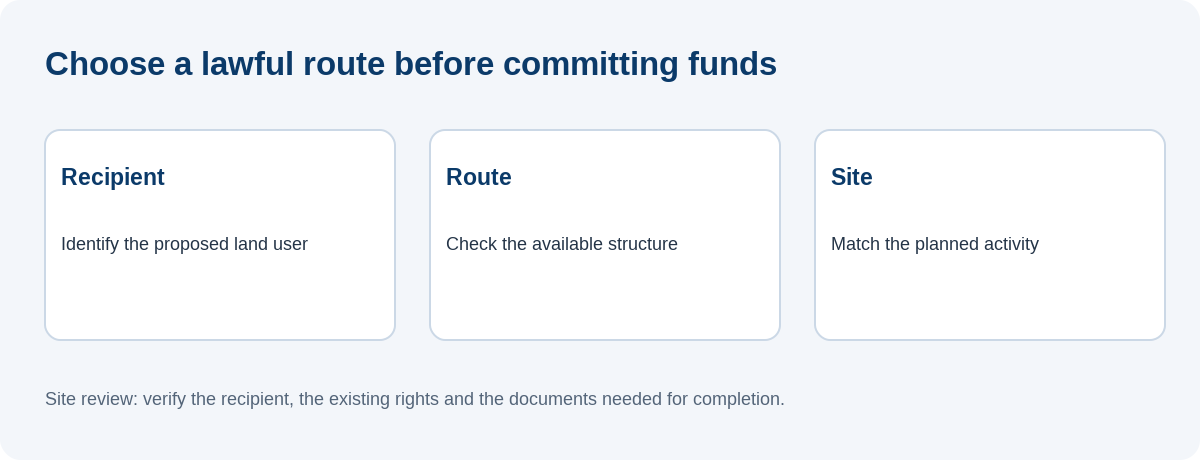
A State lease can be relevant to a foreign-invested project's land requirements. Allocation is a separate mechanism with its own eligible purposes; it is not a general alternative that every foreign investor may select. For example, the statutory framework provides for allocation to foreign-invested economic organisations for qualifying housing projects for sale or sale combined with leasing. A manufacturing proposal should not borrow that explanation as its own entitlement.
Evaluate the actual project route before treating a site as secured. Identify the decisions already issued, the steps still outstanding and the party responsible for them. A proposal, preliminary discussion or contractual undertaking to seek approval should be described as such. It should not be presented to a lender or investment committee as a completed land grant.
Industrial locations may offer a practical route, but the legal structure still matters. Article 28 permits qualifying foreign-invested economic organisations to receive transfers of land-use rights in industrial parks, industrial clusters and high-tech parks. A lease or sublease requires its own examination of the provider's rights and the applicable arrangement. Do not treat every plot marketed as an “industrial site” as legally equivalent.
The provider should explain its authority, the permitted activity, the available area and the remaining term. Obtain the relevant underlying records before accepting assurances that all paperwork is complete. Infrastructure access, handover readiness and service arrangements also deserve separate attention: legal entitlement to a plot does not itself demonstrate that electricity, drainage or vehicle access will meet the project's operational requirements.
The framework also recognises receipt through land-use-right contributions and qualifying transfers of investment capital representing the value of land-use rights, subject to the governing conditions. Those expressions describe particular legal structures. They should not be shortened into a promise that any capital purchase transfers any land. Establish the source of the existing right, the proposed recipient and the requirements of the chosen transaction.
For land use rights for foreign investors in Vietnam, the useful question is therefore not simply which option is cheapest. It is which legally available structure supports the intended activity on the actual site, with an acceptable term, cost and completion risk. Record alternatives and the evidence still needed before selecting one.
Purchasing shares normally changes the ownership of the company; it should not be described as automatically transferring the company's land to the shareholder personally. Review the company's land position alongside the investment and corporate requirements of the acquisition. Changes affecting land registration must be identified from the facts and current rules rather than assumed away because the transaction uses a share purchase agreement.
Buying attached assets is another distinct proposal. A factory building may be offered for sale while the underlying land has a particular lease structure or remaining term. Confirm whether the buyer can obtain the corresponding right to use the site and which steps connect the asset transfer with continued occupation. An agreement to buy equipment or a building should not imply that every associated land right follows automatically.
A project acquisition also requires attention to what is being transferred and what remains to be done. Prepare a schedule separating project approvals, corporate interests, physical assets, contracts and land records. This makes it easier to identify a missing component before signing. It also helps prevent payment for an operating business that cannot continue at its advertised location.
Begin with legible, current copies of the certificate and relevant decisions. Compare the named land user, plot references, area and recorded purpose against the draft agreement and the physical site. Investigate differences instead of treating them as clerical matters. If the proposal includes several parcels or facilities, prepare a parcel-by-parcel schedule rather than relying on one representative certificate.
Check whether the intended activity fits the site's permitted use and project records. A warehouse, manufacturing plant, office and residential development should not be treated as interchangeable uses merely because each occupies a building. Where a change or additional approval is proposed, identify the legal basis, evidence, responsible party and consequences if it cannot be obtained.
Review the remaining land term against the investment's expected operating period. Ask how the provider calculated its offered term and what document supports any extension statement. A contract should distinguish an existing entitlement from an expectation of future approval. Financial modelling should not treat an unconfirmed extension as guaranteed revenue-producing time.
Examine the rent or land-payment structure, outstanding obligations, security interests and other relevant restrictions. Avoid a blanket assumption that every right can be mortgaged, transferred or contributed in the same way. Request evidence for the specific proposed dealing. Where a lender or another party must participate in completion, agree the required documents and sequence before the principal payment becomes due.
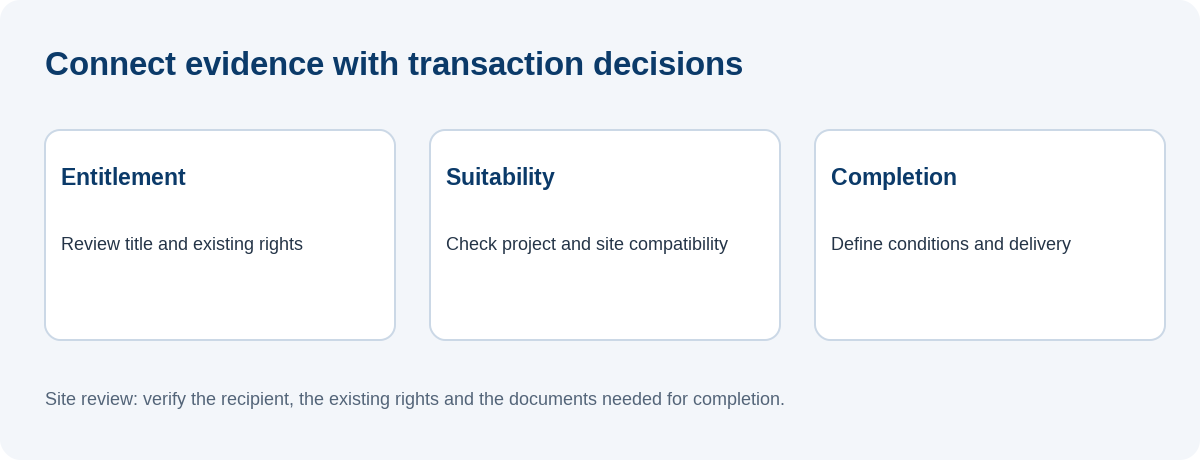
A useful review of land use rights for foreign investors in Vietnam should end with decisions and an action list. Separate issues that prevent the proposed structure from those that can be addressed through documents, conditions or commercial adjustments. Explain what evidence would resolve each point. A list of missing records without an assessment of their significance leaves the investment team unable to decide.
Before a deposit, define its purpose, the circumstances in which it is refundable and the evidence required before further funds are released. Match conditions to the actual uncertainty. For example, if the provider's authority to make the proposed grant remains unverified, a general warranty may provide less practical protection than requiring the relevant evidence before an irreversible payment.
At signing, allocate responsibility for approvals, registration, releases, taxes and fees where applicable, and the preparation of handover records. Specify how the parties will confirm that a condition has been met. Plan for delay, refusal and an unresolved discrepancy in the site documents. These provisions should reflect the chosen structure rather than repeat clauses from an unrelated property transaction.
At handover, reconcile the delivered site and documents with the agreement. Record boundaries, access, outstanding works, keys, utilities and any agreed defects or reservations. Keep the operational team involved: a technically completed transfer can still leave a business unable to start work if the agreed infrastructure or permissions are missing.
Do not assume that an individual's ability to lease to certain recipients makes the proposed lease lawful for a foreign-invested economic organisation. In its September 2026 guidance, the Ministry of Agriculture and Environment rejected that direct land-leasing arrangement in the scenario considered. Distinguish a land-right transaction from a building or premises rental and review the actual recipient and documents before drawing a conclusion.
Compare total cost and execution risk, including outstanding infrastructure, document gaps, conditions, remaining term and potential disruption. A price reduction does not cure a recipient's ineligibility or a mismatch between permitted use and the planned operation. Where the problem is fundamental, another site or structure may be more appropriate than increasingly elaborate contractual assurances.
The site and the investment structure should be reviewed together. The guide to foreign investment procedures in Vietnam provides the broader context for coordinating the investor, project and implementation steps. Use that framework to organise the work, while keeping the land-specific evidence and transaction conditions clearly identified.
For a proposed location, Jurion & Partners can review the proposed recipient, site records and transaction documents as one connected matter. Prepare the available certificate, project information, proposed agreement and details of the intended activity so that the assessment addresses the actual investment rather than a generic description of land access.
Choosing land use rights for foreign investors in Vietnam begins with a lawful recipient and a suitable route, then moves through evidence, conditions and completion. Before committing funds, establish what right will be obtained, how it supports the intended project and what documents will demonstrate that the agreed result has been delivered.






Subscribe today to get more breaking news from Jurion Partners - Solicitors & Litigators

108 Tran Dinh Xu St., Cau Ong Lanh Ward, Ho Chi Minh City, Vietnam
(+8428) 66.701.709 - (+84) 903.419.479
contact@jurionpartners.com
Follow us
Accept payment





 English
 Tiếng Việt