When spouses agree to divorce but property remains unresolved, distinguish no division request from a contested claim and prepare accurate, workable terms.
Consensual divorce and property disputes require a careful distinction between agreement to end the marriage and agreement about what the court is being asked to decide. Two spouses may both want a divorce while continuing to dispute a house, savings or business interests. That does not mean the court can treat every issue as settled. The application should accurately state which matters are agreed, which are excluded from the present request and which remain contested.
Article 55 of the Law on Marriage and Family addresses genuine voluntary divorce and the required agreement concerning property and children. Article 397 of the Civil Procedure Code sets out the procedure for reconciliation and recognition. The legal conditions should be checked against the actual requests, rather than relying on the informal description that the couple are separating amicably.
The word consensual should not conceal a request for the court to choose between competing property claims. Agreement on marital status is important, but it does not make opposing claims about ownership or value disappear. A clear issue list helps identify the suitable route and the evidence needed for the unresolved part.
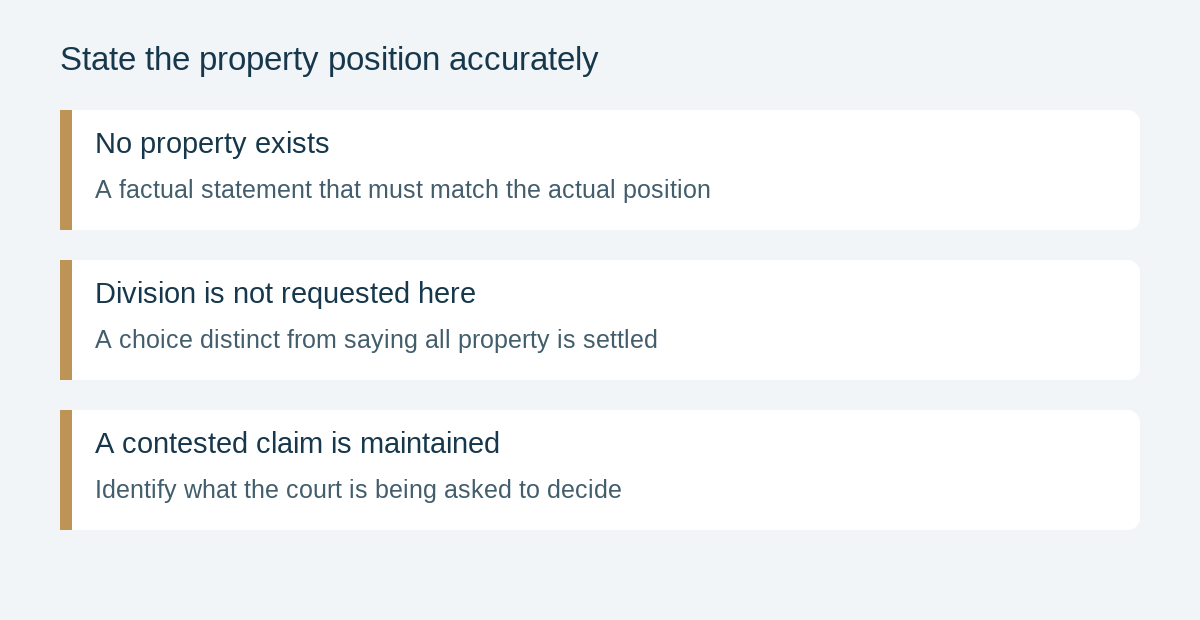
Article 3 of Resolution 01/2024/NQ-HDTP clarifies that agreement about property includes the situation in which spouses do not request the court to resolve its division. It is therefore too broad to say that every couple must finish a detailed allocation of every asset before consensual recognition is possible.
However, declining to request division is different from stating that the spouses have no property, or that all assets have already been finally settled. The wording must reflect the decision actually made. If one person still asks the court to determine an entitlement, that request should not be erased from the papers merely to make the filing look consensual.
Before leaving property outside the present request, consider outstanding debts, possession, access to records and the practical consequences of delay. This is a choice requiring advice about the particular circumstances, not a universal recommendation to postpone difficult issues. Neither spouse should sign a broad release without understanding what it settles.
Assume a fictional couple agree to divorce and have settled the necessary child-related arrangements, but disagree about the value of their home. They must decide whether they are genuinely not asking the court to divide property in the current matter, or whether a property claim is being maintained. Writing “everything agreed” would be inaccurate if one spouse still seeks a judicial allocation.
Article 397 provides for recognition where its conditions are met. Where reconciliation fails and the parties cannot reach the required agreement on the matters identified in the provision, paragraph 5 addresses discontinuing the recognition matter and accepting a case for resolution under the general procedure. This is more precise than promising that the court will simply add a valuation exercise to an otherwise unchanged consensual process.
The actual procedural position depends on the filing and stage reached. If proceedings have already begun, provide the existing application, acceptance information, subsequent requests and court directions. Do not prepare a fresh set of papers that contradicts an outstanding property claim without explaining how that claim is to be addressed.
A change in route may affect evidence, participation, costs and the timetable. No fixed completion date should be promised merely because both spouses agree on divorce. A disputed asset involving other owners or creditors may require work beyond confirming the spouses' wish to end the marriage.
For consensual divorce and property disputes, a practical schedule should separate marital status, children, assets, liabilities and implementation. Mark each subject as agreed, not requested in the current matter or disputed. Do not use those labels interchangeably. A private intention to discuss an item later should correspond with the wording in the documents submitted.
| Subject | Question to resolve before filing |
|---|---|
| Marital status | Are both spouses genuinely requesting divorce? |
| Children | What care, support and other arrangements are agreed or disputed? |
| Property | Is division requested, settled, or intentionally outside the current request? |
| Debts | Which creditors and obligations may be affected? |
| Implementation | What payments, handovers or registration steps remain? |
The schedule is a working document, not a substitute for the required application. Its purpose is to reveal inconsistencies early. If one draft says no property exists while another lists a disputed apartment, correct the underlying instruction before either document is signed.
Where division is requested, identify the applicable property regime and the assets falling within it. Articles 33 and 59 of the Law on Marriage and Family are relevant starting points under the statutory framework. A certificate bearing one name or an acquisition during marriage should not be treated as a complete answer without considering source and the relevant exceptions.
Collect transaction documents, funding records and any agreement relied upon. If an asset was bought using a mixture of funds, explain the competing positions rather than assuming it must follow a single label. A clear classification dispute is easier to assess than an argument that every asset should be split simply because divorce is agreed.
Article 59 provides for division in half while taking account of specified factors. Those include contributions, family circumstances, legitimate occupational and business interests and fault in violating marital rights and obligations. Domestic work is relevant; a spouse should not be described as contributing nothing solely because they received no salary.
The factors need evidence and a connection to the proposed result. A statement that a person was the main earner does not automatically establish a particular share. Likewise, an allegation of misconduct should not be converted into a fixed financial penalty without examining the applicable rule and facts.
When negotiating consensual divorce and property disputes, distinguish the legal assessment from a compromise the parties are willing to accept. A voluntary offer may differ from the outcome each person would ask a court to order. Documents should make clear what is being agreed without presenting a negotiated figure as the only possible legal result.
A premarital property-regime agreement and an agreement made during marriage are not interchangeable merely because both concern assets. Article 47 requires the agreement establishing that regime to be made before marriage in a notarized or authenticated written document; the regime is established from marriage registration. Later amendments and other property arrangements need to be classified under their relevant rules.
Provide the complete agreement, proof of its form where relevant and any amendments. Avoid relying on the claim that “we have a prenup” without checking what the document says and whether it governs the disputed item. Questions about invalidity, incomplete terms and implementation should be identified before the settlement is drafted around them.
An agreement between spouses does not automatically release either of them from a lender's rights. Article 60 addresses rights and obligations involving third parties. Obtain the loan and security documents and distinguish allocation between spouses from obligations owed to someone else.
Business interests need similar precision. A spouse's shareholding and the company's assets are different subjects. A promise to transfer a company-owned vehicle as if it belonged personally to a spouse may be impossible or require additional legal steps. Identify ownership and third-party rights before using the asset as part of a settlement balance.
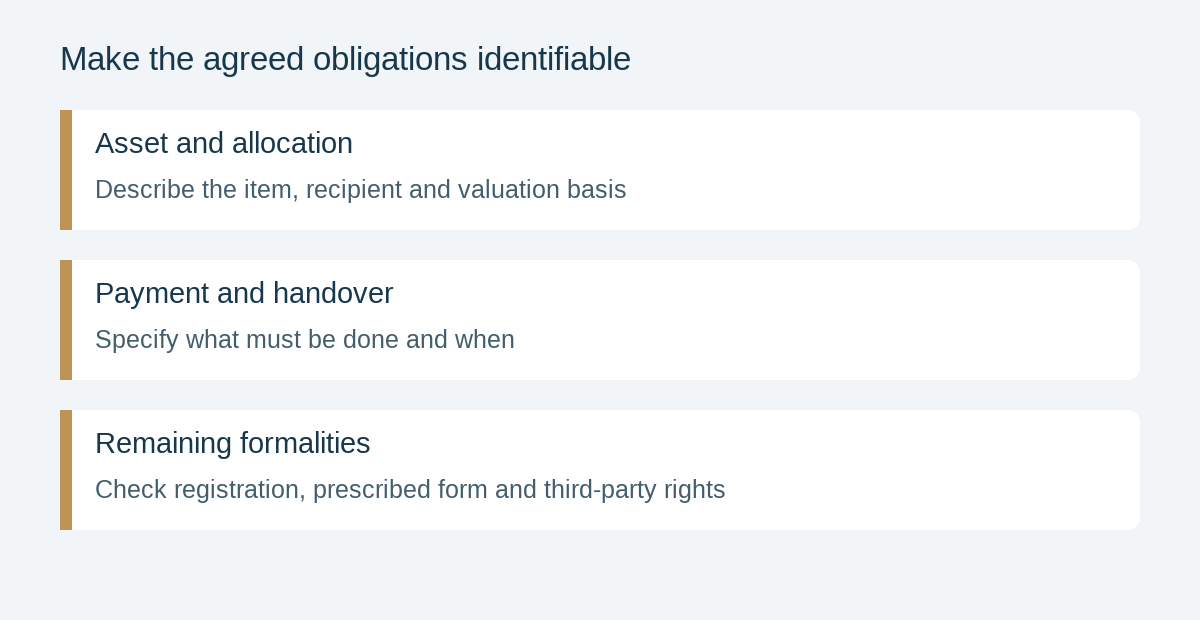
If property is agreed, identify the asset, recipient, valuation basis and any equalizing payment. Set out when payment and delivery occur and what formalities remain. Vague wording that one spouse will pay “when able” may leave the central disagreement unresolved.
For property requiring registration or a transaction in a prescribed form, check those requirements separately. A signed family document should not be presented as automatically completing a title change. Also distinguish a private promise from an agreement recognized in a court decision and consider the appropriate enforcement route if performance fails.
Property bargaining must not conceal an unresolved arrangement for children. The conditions for recognition require attention to the legitimate interests protected by law. Avoid treating maintenance, direct care or contact as items to exchange for an adult's property concession without examining the child's rights.
Both spouses should understand the terms and the scope of any confirmation. Where language assistance is needed, arrange it appropriately. Pressure to sign quickly or wording that a person does not understand can undermine the assumption that the agreement is genuinely voluntary and informed.
The guide to drafting a lawsuit petition in Vietnam explains how to organize requests and supporting materials. The correct filing for the family matter must reflect whether recognition is sought or contested claims require resolution. Legal assistance should also be distinguished from an authorized replacement for a spouse in divorce proceedings, which Article 85 of the Civil Procedure Code restricts.
Jurion & Partners can review the issue schedule and draft terms within an agreed scope. When addressing consensual divorce and property disputes, make the actual choices visible: what is agreed, what is not requested and what still needs a decision, together with the evidence and practical steps each choice requires.






Subscribe today to get more breaking news from Jurion Partners - Solicitors & Litigators

108 Tran Dinh Xu St., Cau Ong Lanh Ward, Ho Chi Minh City, Vietnam
(+8428) 66.701.709 - (+84) 903.419.479
contact@jurionpartners.com
Follow us
Accept payment





 English
 Tiếng Việt