Understand direct care, children’s wishes, contact, maintenance and changes after divorce in Vietnam. Prepare a practical parenting proposal and supporting evidence.
Child custody rights in Vietnam should be understood through the child's interests, the allocation of direct care and the continuing responsibilities of both parents. Divorce does not turn a child into an asset to be divided, nor does it automatically remove the rights and duties of the parent who does not provide daily care. A useful proposal explains how the child will live, study, receive support and maintain appropriate relationships after the parents separate.
Articles 81 to 84 of the Law on Marriage and Family address care after divorce, the responsibilities of each parent and changes to the person directly raising the child. Parents may agree on arrangements; where agreement is not reached, the court considers the child's interests under the applicable rules. An agreement must be assessed in that context rather than treated as an unrestricted bargain between adults.
English expressions such as sole custody and joint custody can mean different things in different countries. They should not be presented as a complete statutory classification that a Vietnamese court simply chooses between. Describe the actual request: who will directly raise the child, the other parent's contact and support, and how relevant responsibilities will be performed.
Identify each child separately. Siblings may have different ages, health needs or schooling circumstances, while their relationship with each other also matters. A proposal copied from another family's dispute may overlook the very facts the court needs to understand.
Article 81 contains a rule for children under thirty-six months: direct care is assigned to the mother, subject to the statutory exceptions concerning her conditions for care or another parental agreement consistent with the child's interests. It should not be described as an absolute result in every case, or merely a preference with no legal significance.
The Resolution also explains the under-thirty-six-month exception by reference to specified serious health limitations, monthly income below half the monthly regional minimum wage where the mother resides together with no other assets for providing care, or lack of minimum time for direct care. Where the father’s care conditions are not better than the mother’s conditions addressed by that guidance, Article 6 directs the court to assign direct care to the mother. A bare statement that the mother earns less does not adequately apply those conditions.
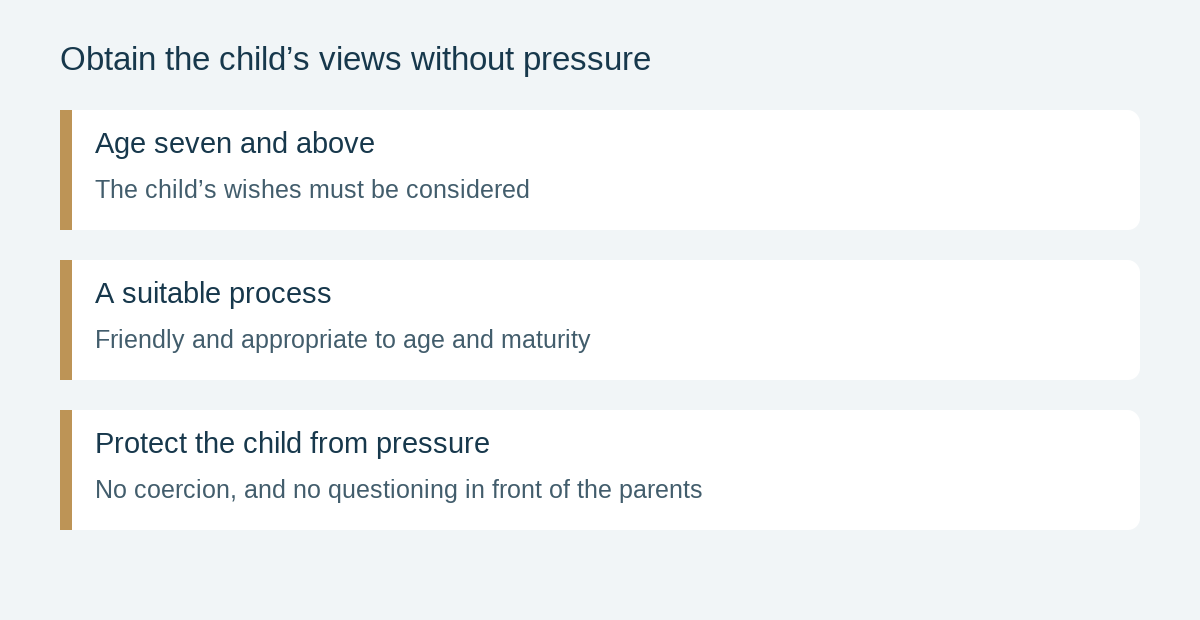
For a child aged seven or above, the child's wishes must be considered. The threshold includes the seventh birthday; it is not limited to children older than seven. Considering wishes does not mean the child alone determines the outcome. The court must assess the relevant circumstances and interests rather than ask the child to bear responsibility for the dispute.
Parents should avoid coaching, threats or promises designed to obtain a preferred answer. A statement prepared by an adult and signed by the child is not a substitute for a reliable assessment of the child's views. Discuss the appropriate way for those views to be obtained through the procedure being followed.
Article 6 of Resolution 01/2024/NQ-HDTP requires an age-appropriate, friendly process for obtaining the child’s views, without pressure and without the parents being present. Parents should cooperate with that process rather than arrange a confrontation in which the child must answer in front of them.
A higher salary does not by itself establish that a parent should provide direct care. Explain who can meet the child's everyday needs, provide suitable living conditions and attend to schooling and health. Financial resources should be connected to a workable plan, rather than presented as a competition over which adult earns more.
Prepare information about working hours, accommodation, current routines, practical support and the child's needs. If relatives will help, explain their role realistically. A general assertion that grandparents are available may leave unanswered who will collect the child, supervise homework or respond when the child is ill.
Assume one parent has a higher income but travels frequently, while the other has a more predictable schedule. Neither fact settles the case alone. The proposed arrangements need to explain supervision, stability and how each parent's contribution will work in practice. Evidence should address the child's life, not only the parents' employment titles.
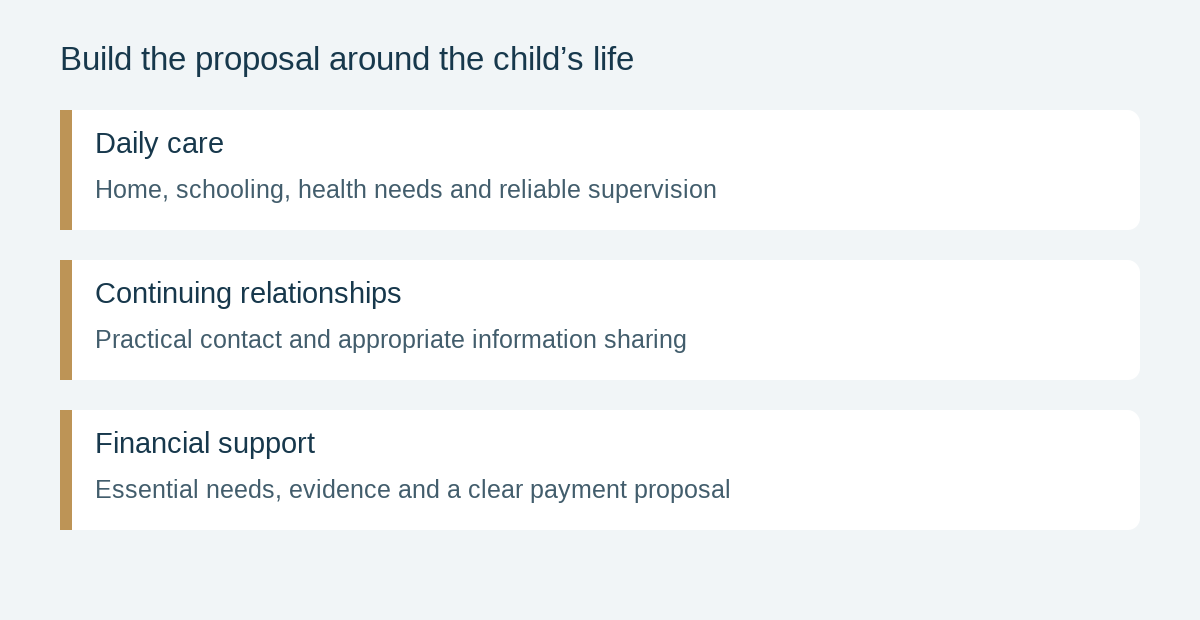
A plan should state where the child will live, the schooling arrangement, how necessary information will be shared and how contact will occur. Identify the practical details that are already agreed and those still disputed. Vague language such as “the parents will cooperate” may be insufficient when the disagreement concerns travel, handovers or a school change.
| Topic | Practical information |
|---|---|
| Daily care | Home, supervision, routine and available support |
| Education and health | Current needs, records and arrangements for important information |
| Contact | Timing, handovers, communication and foreseeable travel issues |
| Maintenance | Needs, payment proposal and evidence of financial capacity |
| Safety concerns | Specific events, supporting records and protection sought |
The proposal should remain proportionate to the family's actual circumstances. It need not predict every future disagreement, but it should address problems already apparent. Separate an immediate temporary arrangement from the final request so that a short-term practical solution is not misrepresented as full agreement.
Articles 82 and 83 address the position of the parent who does not directly raise the child and the obligations of the direct-care parent. Appropriate contact should not be obstructed simply because the adults disagree. Equally, the law provides a route to seek restrictions where contact is abused in the manner specified by the legislation.
Identify actual concerns rather than using an allegation as a reason to impose any restriction unilaterally. If there is a safety issue, obtain advice promptly about the available protective procedure. An informal agreement between the adults should not be assumed to provide every form of protection a child may need.
Maintenance and contact should not be treated as reciprocal bargaining chips. A disagreement about payment does not automatically authorize blocking contact, and a contact dispute does not automatically cancel support obligations. Record each problem and pursue the relevant remedy on its own basis.
Article 116 connects the amount of maintenance with the responsible person's income and actual capacity and the recipient's essential needs, with court resolution where agreement cannot be reached. A useful request includes a realistic account of the child's expenditure and available financial information. Avoid assuming a universal percentage applies to every household.
Article 7 of Resolution 01/2024/NQ-HDTP adds a floor where the parties cannot agree and the court determines support: for each child per month, the court-determined amount must not be lower than half the monthly regional minimum wage at the supporting parent’s place of residence. Check the currently applicable region and rate. This is distinct from assuming a fixed percentage of salary or applying an outdated wage table.
Distinguish routine needs from unusual expenses and identify the payment arrangement proposed. Keep receipts and records without exaggerating the child's budget to punish the other parent. Where information is unavailable, say what is known and what needs to be obtained rather than presenting guesses as verified income.
Payment frequency, method and proof should be clear enough to reduce future disputes. If circumstances later require a change, use the relevant agreement or legal procedure. A parent should not simply stop performing an existing obligation because their preferred new amount has not been accepted.
For child custody rights in Vietnam, organize the birth record, relevant family documents, schooling and health information, evidence of present care and material supporting the proposed home and resources. Keep the child's private information within an appropriate audience. Publicly posting sensitive material can create further harm without assisting the legal assessment.
A chronology should separate direct observations from statements reported by others. If relying on violence, neglect or other harmful conduct, identify the events and available supporting records. Avoid making unsupported accusations or assuming marital fault automatically decides the direct-care issue.
Do not obtain records through unauthorized access or pressure the child to collect evidence against a parent. Where material is held by another person or institution, consider the proper way to request it. A clear list of missing documents is more useful than an incomplete file presented as conclusive proof.
Separate arrangements sought within divorce proceedings from a later request to change direct care. For child custody rights in Vietnam, the current regional People’s Court structure, specialized division of work, territorial rules and any foreign element must be assessed for the specific matter. Older instructions referring generically to a local Family Court should not substitute for identifying the court that has competence.
Parties should also distinguish legal assistance from an authorized substitute in the divorce itself. Article 85 of the Civil Procedure Code restricts representation by authorization in divorce proceedings. A lawyer can advise and protect lawful interests within the applicable role, while participation and absence need their own procedural assessment.
Where parents live in different countries, consider service, evidence, language and the practical effect of the proposed order. A custody-related decision should not be assumed automatically to settle passports, immigration permission or every relocation issue. Identify those questions before promising a cross-border arrangement.
Article 84 sets out grounds for changing the person directly raising the child, including an agreement consistent with the child's interests or the existing carer's failure to retain the required conditions. The child's wishes from age seven must also be considered in the prescribed assessment. A generic statement that circumstances have changed is not a complete legal basis.
Explain what has changed, how it affects care and what new arrangement is requested. A new job, move or disagreement is a fact to examine, not an automatic entitlement to a different outcome. Keep the existing decision and supporting records so that the request can be compared with the arrangement currently in force.
The guide to drafting a lawsuit petition in Vietnam explains how to organize parties, requests and supporting documents. For a child-related matter, the filing should make the proposed care, contact and maintenance arrangements identifiable and explain the evidence relevant to each.
Jurion & Partners can review the family circumstances and proposal within an agreed scope. Before pursuing child custody rights in Vietnam, prepare a factual account of the child's needs and a practical plan that supports their welfare while addressing the continuing responsibilities of both parents.






Subscribe today to get more breaking news from Jurion Partners - Solicitors & Litigators

108 Tran Dinh Xu St., Cau Ong Lanh Ward, Ho Chi Minh City, Vietnam
(+8428) 66.701.709 - (+84) 903.419.479
contact@jurionpartners.com
Follow us
Accept payment





 English
 Tiếng Việt