Vietnam growing economy and investor-friendly policies have made it an attractive destination for foreign capital contribution.
Capital contribution investment in Vietnam requires an investor to identify what is being acquired, who receives the money and which rights follow from the transaction. Funding a company through a new contribution is different from buying an existing owner's interest. Both may produce an ownership position, but their commercial purpose, documents and payment arrangements can differ. A sound investment plan starts with that distinction rather than a general assumption that every foreign investor needs the same certificate before transferring funds.
Identify whether the proposal involves formation of a new company, an increase in an existing company's capital or a transfer from a current holder. Record the parties, the amount, the intended recipient and the resulting ownership. A short structure diagram can reveal an inconsistency early, such as describing money paid to a seller as working capital received by the company. The agreement and the financial plan need to describe the same transaction.
Capital contribution investment should also be distinguished from a loan, a cooperation arrangement or payment for services. The label chosen by the parties does not resolve the legal treatment of their actual rights and obligations. If the investor expects repayment, a fixed return or ownership in particular assets, those expectations need to be examined. Avoid treating a promise of commercial cooperation as proof that the investor has acquired an equity interest.
A new contribution may provide resources to the business, while a purchase from an existing owner generally involves consideration for that owner's interest. A transaction can contain both elements. In that case, separate the amounts and completion steps. The parties should know which conditions apply to each payment and what happens if one element cannot proceed. Combining all amounts into a single undefined “investment payment” can create uncertainty for the company, seller, investor and bank.
Prepare a table showing the current holders and the proposed position after the transaction. Include the relevant classes or forms of interests and identify any commitments to issue or transfer additional interests. The calculation should be checked against the company's records rather than based only on a presentation from management. Ask whether the agreed percentage is measured before or after another planned financing, since the answer may materially affect the investor's position.
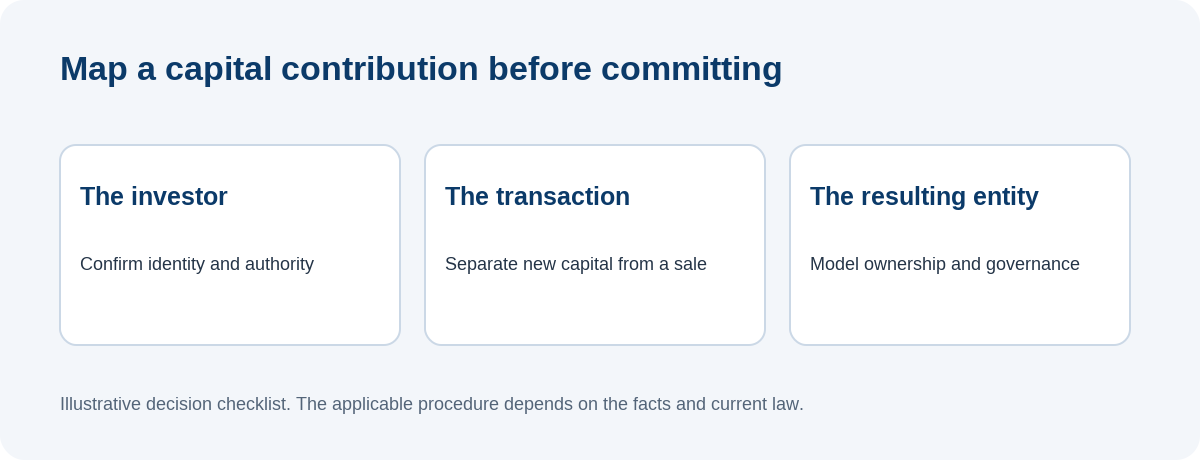
For capital contribution investment, the relevant assessment includes the investor's identity, the target's actual activities and applicable market-access conditions. A company's broad business description may not be sufficiently precise. Establish what products or services it provides and which activities the investor intends to support. Where the company operates several business lines, review the combination rather than assuming that approval for one activity answers every question.
The Investment Law No. 143/2025/QH15 and Decree No. 96/2026/ND-CP form part of the framework to examine for a transaction in 2026. The proposed ownership and the relevant conditions need a case-specific assessment. Do not rely on an old checklist that treats an investment registration certificate as the universal result of every contribution or acquisition. Project registration, transaction-related procedures and corporate updates should be distinguished.
For an individual, verify identity and the information needed for the relevant process. For an organisation, establish its legal existence, ownership structure and the authority of the person approving or signing the investment. Documents prepared abroad may require particular treatment before use in Vietnam. The required form should be checked for the document and procedure, rather than assuming every foreign paper follows an identical authentication route.
Review the company's legal and commercial position in proportion to the investment. The records may include corporate documents, material contracts, financing arrangements, assets, permissions and employment matters. A small ownership percentage does not necessarily mean the underlying business has limited risk. The review should identify issues that affect valuation, completion, governance or the investor's ability to realise the intended benefit.
Pay attention to restrictions on the proposed transaction. Corporate documents or existing agreements may contain consent, pre-emption or other relevant provisions that require analysis. Do not assume a person presenting an offer can deliver an unrestricted interest. If an issue is found, decide whether it needs to be resolved before completion, addressed in the price or allocated expressly in the documents. Merely listing it in a report does not determine the parties' response.
| Issue | Commercial question | Document check |
|---|---|---|
| Funding | Who receives each amount and for what purpose? | Contribution or transfer terms and payment instructions |
| Ownership | What interest exists after all planned transactions? | Corporate records and the ownership calculation |
| Conditions | What needs to happen before completion? | Regulatory analysis, consents and agreed evidence |
| Governance | How can the investor participate and obtain information? | Charter, agreements and decision-making arrangements |
Capital contribution investment involves more than an economic percentage. Consider voting, appointment rights, information access, reserved matters and the treatment of later financing. These issues must be assessed under the applicable corporate framework and reflected consistently in the relevant documents. A commercial promise in one agreement should not be assumed to override every provision in the company's charter or the law.
Suppose the business needs additional funding six months after completion. Who may approve it, what information must be provided and how will the investor's position be affected? A second example is a proposed sale of a material asset. Testing these decisions can expose a gap between the investor's expectations and the actual governance arrangements. Resolve the gap before signing rather than relying on a general assurance that the parties will cooperate.
Expected returns should be distinguished from an unconditional promise of immediate distribution. The company's performance, financial position and applicable requirements matter. The documents should explain the commercial assumptions without suggesting that an ownership interest guarantees a particular dividend. Where transfer of funds abroad is contemplated, tax, banking and foreign-exchange requirements need separate assessment using the actual transaction record.
The parties should coordinate with the receiving bank on the proposed transaction, the payer, recipient, currency and supporting documents. A payment to the company is not interchangeable with payment to a selling holder. Do not assume the investor may use any account simply because the funds will ultimately support an investment. The banking route and evidence should be checked before a payment becomes difficult to explain or reverse.
Also distinguish preparatory expenses, deposits and completion consideration. A deposit agreement needs to address its purpose, conditions, treatment if the transaction does not proceed and the relationship with later payments. It should not be treated as a shortcut around a required procedure. Keep the contractual record, bank evidence and the final allocation of amounts consistent so that the transaction can be reconstructed from its documents.
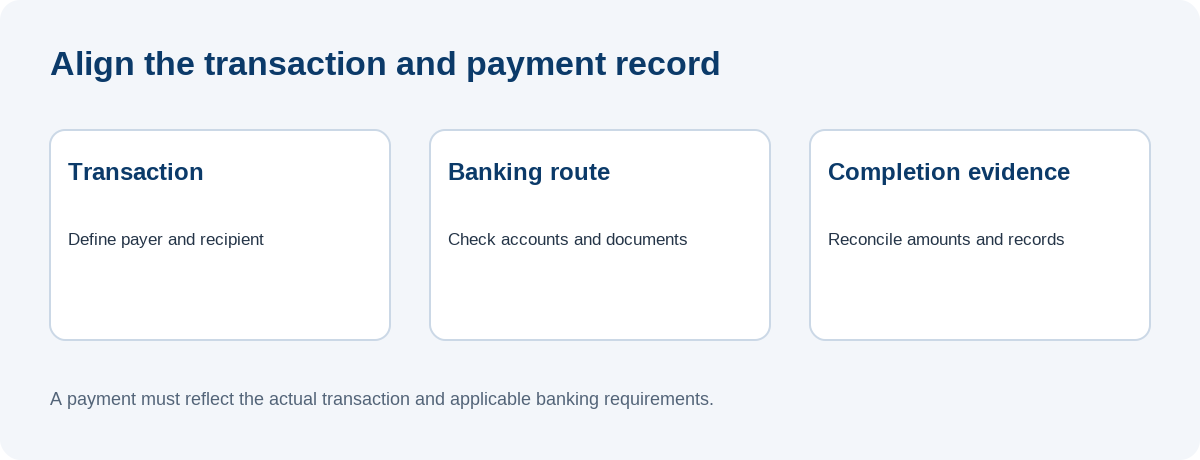
Capital contribution investment needs a sequence that separates signing, fulfilment of conditions, payment and completion records. Identify any required investment-related step and the corporate filings or records affected by the resulting ownership. The sequence depends on the transaction and cannot be reduced to a universal instruction to obtain one certificate and then transfer money. A private agreement cannot replace a mandatory requirement.
Prepare a closing checklist linked to the final documents. Each item should have an owner and a clear form of evidence. Examples include an agreed approval, a signed document, a verified payment or a corporate record that requires updating. Reconcile the checklist when the transaction changes. A checklist copied from another investment may omit a material condition or require a document that does not apply.
Once completion occurs, establish who maintains corporate documents, monitors continuing undertakings and organises information for the investor. A right to receive reports has limited practical value if no one knows the reporting dates or the material to provide. The operating team should understand any agreed approval process rather than discover it only after a disputed decision.
Future transfers, additional funding or changes in business activity may require another legal assessment. Preserve the original transaction record, including the basis for the ownership calculation and relevant procedures. Avoid treating the completion of one investment as permanent confirmation that every later transaction can follow the same route. The facts and legal requirements may differ.
A business discussing the transaction with Jurion & Partners can provide the ownership table, proposed structure, target activities, current drafts and a list of unresolved issues. Clarify whether the work concerns eligibility, due diligence, negotiation, payment planning or completion support. These tasks can be related without being identical, and the scope should reflect the work actually needed.
The broader guide to foreign investment procedures in Vietnam helps place the proposed contribution within the wider investment framework. Use that context while keeping the transaction-specific distinction between funding the company and buying an existing holder's interest.
Capital contribution investment should give the investor a clearly defined position supported by lawful procedures, workable documents and a coherent payment record. Confirm the structure, eligibility and governance before committing funds. That preparation provides a stronger basis for managing the investment than relying on the ownership percentage or assuming a certificate alone resolves every legal issue.






Subscribe today to get more breaking news from Jurion Partners - Solicitors & Litigators

108 Tran Dinh Xu St., Cau Ong Lanh Ward, Ho Chi Minh City, Vietnam
(+8428) 66.701.709 - (+84) 903.419.479
contact@jurionpartners.com
Follow us
Accept payment





 English
 Tiếng Việt