When businesses enter into mergers and acquisitions (M&A), one of the most decisive factors is the valuation of assets.
Asset valuation in M&A depends on more than a figure in a financial model. The parties need to understand which asset or right is being valued, who holds it and what the buyer can obtain through the proposed transaction. A valuable operating resource may belong to another group company, be used under a limited licence or depend on arrangements that do not continue as expected.
Legal review helps test those assumptions and connect them with the deal documents. It does not replace the work of financial, tax or valuation specialists. This article explains the legal questions that can affect an asset's usefulness, transferability and treatment in an acquisition, and how the transaction team can turn findings into decisions.
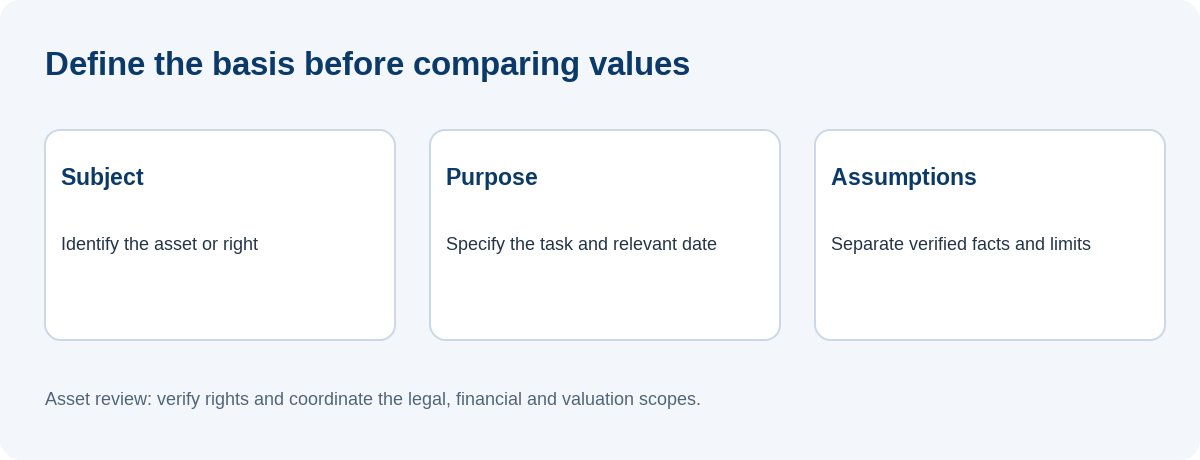
Start with a precise description of the subject: an individual asset, a contractual right, a business interest or the value attributed to a group of resources. These are not interchangeable. A share price reflects a transaction involving the company, while a value assigned to a particular property or licence concerns a different object and may use different assumptions.
Clarify the purpose and relevant date of the exercise. A figure prepared for one task should not automatically be reused for another without checking its basis and limitations. If the transaction team refers to several reports, identify what each report measures and whether the figures can be compared meaningfully.
The parties' negotiated price, a financial model and a formal valuation appraisal serve different functions. Vietnam's price and appraisal framework includes professional requirements and valuation standards. Identify whether a particular appraisal requirement applies to the transaction and purpose; do not assume that every private M&A price is determined through an identical mandatory appraisal process.
Where a specialist report is needed, define its scope and the legal information to be supplied. The legal and valuation teams should know which issues are verified, which remain assumptions and which fall outside the assignment. A report's existence does not establish that its assumptions about title or transfer have been independently confirmed.
A central question in asset valuation in M&A is whether the target owns the resource or only has permission to use it. Inspect the relevant acquisition, registration, licensing or other records. An asset appearing in a management presentation should be traced to the entity and right that the transaction actually concerns.
For example, a manufacturing business may use equipment owned by a related company or software licensed under a group arrangement. A brand used by the target may be held by another entity. The review should identify the available right and the steps required for the intended use after completion, rather than assume that operational access is equivalent to ownership.
Where evidence is missing or inconsistent, make the uncertainty visible. State which document or confirmation could resolve it and why the issue matters to the proposed value. Do not silently treat an unverified resource as an unrestricted asset of the target simply because it contributes to current revenue.
An asset may have value while being subject to conditions that limit how the buyer can use it. Review the remaining term, permitted activity, territorial scope and other relevant restrictions. The importance of a limitation depends on the investment plan. A right suitable for current operations may not support the expansion assumed in the buyer's forecast.
Transfer and change-of-control provisions need transaction-specific analysis. A share purchase and an asset purchase can affect contractual arrangements differently. Identify whether consent, notification or another step is required under the actual documents and applicable rules. A seller's willingness to transfer does not establish that every necessary third party has agreed.
Where a benefit depends on extending a lease or licence, distinguish the existing term from a hoped-for renewal. The financial team should understand whether an extension is secured, conditional or merely expected. An assumption about future cooperation should not appear as a verified entitlement in the legal review.
For property-related assets, distinguish land-use rights, ownership of attached assets and the arrangements supporting occupation. Compare the recorded rights, remaining term and permitted use with the planned operation. An attractive location does not answer whether the proposed recipient can obtain the intended right or use it for the desired purpose.
Also separate legal entitlement from technical and operational condition. A building's title review does not confirm its physical performance, and a technical inspection does not establish that all relevant legal rights are available. Explain the respective scopes so that one report is not treated as covering another team's unanswered question.
For technology, brands and other intangible resources, identify what the target controls and the evidence supporting that position. Review ownership chains, licences and restrictions relevant to the proposed use. Describing a business as having valuable intellectual property is not enough to determine which rights can be acquired or maintained.
Customer and supplier arrangements may also support the business case. Examine whether the expected benefit depends on a particular agreement, an informal relationship or future negotiations. If an important agreement can end or change in the transaction circumstances, that dependency should be communicated to the valuation team and decision-makers.
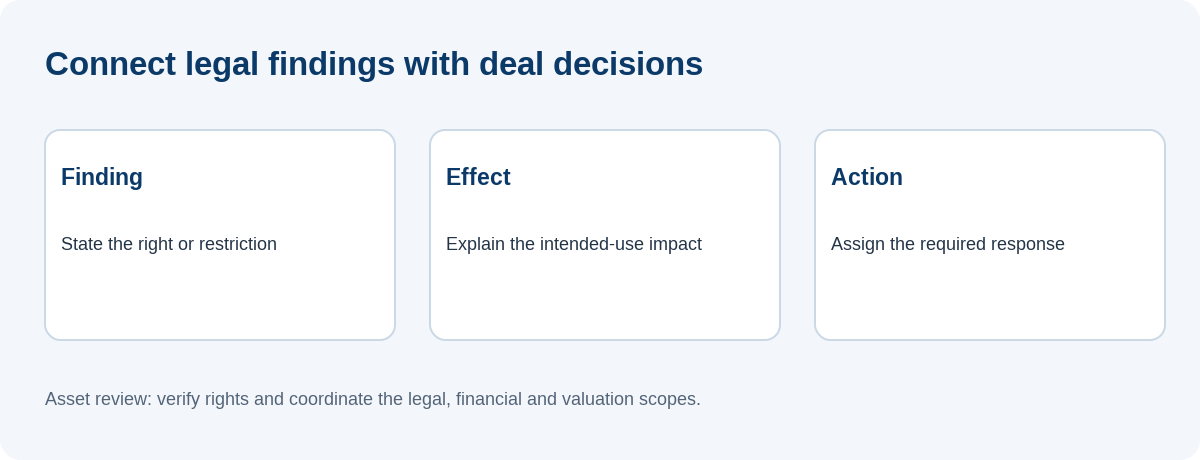
Legal findings affecting asset valuation in M&A should be translated into clear instructions for the relevant specialists. Identify the assumption, supporting evidence and unresolved condition. The legal team should explain the nature of the risk without pretending to calculate a value outside its agreed expertise.
A useful schedule can connect each material asset with its holder, source document, restriction and proposed transaction treatment. If a finding changes the period over which the asset can be used or the cost of maintaining access, the financial team can then assess the effect using an appropriate methodology.
Use scenarios where a material assumption remains unresolved. For example, compare the case in which a required permission is obtained with the case in which it is not. The purpose is to inform the decision, not to suggest that assigning a discount makes a legally unavailable transaction acceptable.
The parties should understand how asset values relate to the overall price mechanism. A resource may already contribute to a business valuation through expected income; adding a separate figure without reviewing the methodology can create an inconsistent explanation of value. Financial specialists should reconcile the approach, with legal input on the rights and obligations being assumed.
Check the contract definitions and schedules against that understanding. If an asset is excluded, or access depends on a separate arrangement, the price and completion obligations should not imply otherwise. Similarly, associated liabilities or release costs should not be overlooked because the negotiation focuses on the asset's headline value.
Tax and accounting treatment require their own assessment. A negotiated allocation or legal description does not automatically establish every tax consequence or reporting result. Identify which advisers must review the treatment and what assumptions they need confirmed before the parties rely on it.
A review of asset valuation in M&A is most useful when it leads to a decision about the transaction. A missing title record, unresolved permission or security release may require further investigation, a condition or a different arrangement. The response should match the issue rather than rely on a broad warranty to address every uncertainty.
The wider legal due diligence process helps place asset findings alongside corporate authority, material contracts and other obligations. Keep the valuation workstream connected to that review so the deal team sees both the resource and the conditions affecting its availability.
At completion, specify the documents and actions demonstrating the agreed outcome. That may involve evidence of transfer, continuing use, a consent or a release, depending on the structure. After completion, give the operating team the records and information it needs to manage limitations and outstanding commitments.
Before commissioning work, assemble the asset list, available ownership and use records, proposed transaction structure and intended business plan. Ask the legal, financial and valuation advisers to identify their respective scopes and the points on which they depend on one another. This reduces the risk that an important assumption falls between assignments.
When discussing legal support with Jurion & Partners, highlight the assets driving the investment case and the evidence currently available. The review can then prioritise the rights, restrictions and transaction steps that matter to the decision, while valuation conclusions remain with the appropriate specialists.
Reliable asset valuation in M&A connects the proposed figure with an asset the target actually holds and a use the transaction can support. Define the subject, verify the rights and make material assumptions visible. That foundation allows the parties to assess value and negotiate implementation on a clearer basis.






Subscribe today to get more breaking news from Jurion Partners - Solicitors & Litigators

108 Tran Dinh Xu St., Cau Ong Lanh Ward, Ho Chi Minh City, Vietnam
(+8428) 66.701.709 - (+84) 903.419.479
contact@jurionpartners.com
Follow us
Accept payment





 English
 Tiếng Việt